
TL;DR
What is this guide about?
How to use casestudies.com a public database of 902,504+ B2B customer case studies as a source of high-intent outbound prospects, and how to verify those email addresses with MailValid before sending.
Why casestudies.com for outbound?
Every company in the database completed a full B2B buying cycle: identified a problem, had budget, purchased a solution, and publicly approved the vendor's use of their name. That's stronger intent than any cold contact list scraped from Apollo.
The 9 tactics covered: 1. Mine competitor case studies for pre-qualified prospects 2. Build lookalike lists from actual buyers — not guesses 3. Target companies sitting on underused proof (agencies angle) 4. Sell the proof distribution offer (one case study = 8+ campaign assets) 5. Write outbound emails in the buyer's actual language 6. Find the department that actually owns the budget 7. Build competitor displacement campaigns without being aggressive 8. Find the vendor proof gap in your category 9. Map entire B2B categories to find the best markets to target
The one step before you send:
Email addresses enriched from tools like Apollo or Hunter can carry 5–20% stale or invalid contacts. ISPs flag senders whose bounce rate exceeds 2%. Verify every email with MailValid ($0.001/email) before your campaign goes out — 100 free credits, no card required.
Best categories to target on casestudies.com:
Cybersecurity · Compliance · AP Automation · ERP · CRM · AI Sales Tools · Business Process Automation · Cloud Consulting · Procurement Software · Customer Support Platforms
Most outbound teams are doing the same thing. They open Apollo, filter by industry and headcount, export 2,000 contacts, and blast cold emails into the void. Reply rates are under 1%. Domains get flagged. And the underlying problem is never the copy - it's the list.
The list is cold. The contacts have no demonstrated buying intent. Nobody told you they care about the problem. You're guessing.
There's a better starting point, and most outbound teams walk right past it every day.
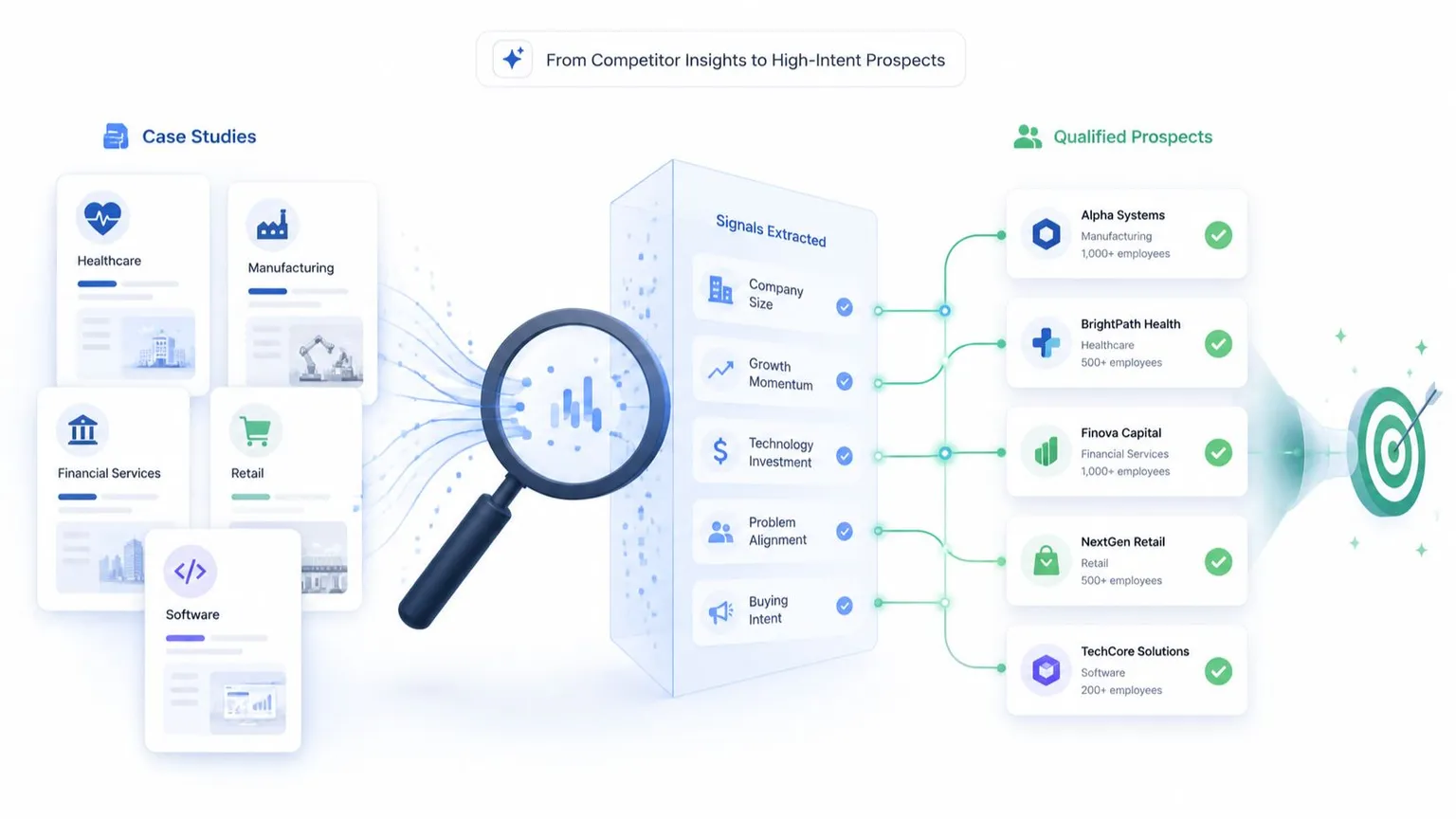
CaseStudies.com is a public database of 902,504+ verified B2B buying events. Every case study in that database represents a company that identified a problem, had budget, bought a solution, went through implementation, got a result, and allowed the vendor to talk about it publicly. That's not a lead. That's a proven buyer.
This guide walks through 9 ways to use that database to build lists, write sharper copy, and open conversations that start warmer than anything Apollo alone can give you - along with one critical step before you send a single email.
What Is casestudies.com and Why Outbound Teams Should Care
CaseStudies.com is a platform hosting over 900,000 real-world B2B customer case studies, success stories, and customer proof documents from companies across SaaS, healthcare, manufacturing, fintech, cybersecurity, compliance, CRM, ERP, AP automation, and dozens of other categories. It is free to browse, searchable by company name, category, and industry, and updated continuously as vendors publish new customer stories.
For a buyer, it's a research tool. For an outbound team, it's a database of companies that already understood a problem, allocated budget, and made a purchasing decision - with the vendor, approximate category, and sometimes the buyer's title listed right there in the case study.
The insight is simple: a company featured in a public case study is not cold. They are educated, they have a budget, and they have public proof that they buy solutions like the one you sell.
9 Outbound Tactics Using casestudies.com
1. Mine Competitor Case Studies for Pre-Qualified Prospects
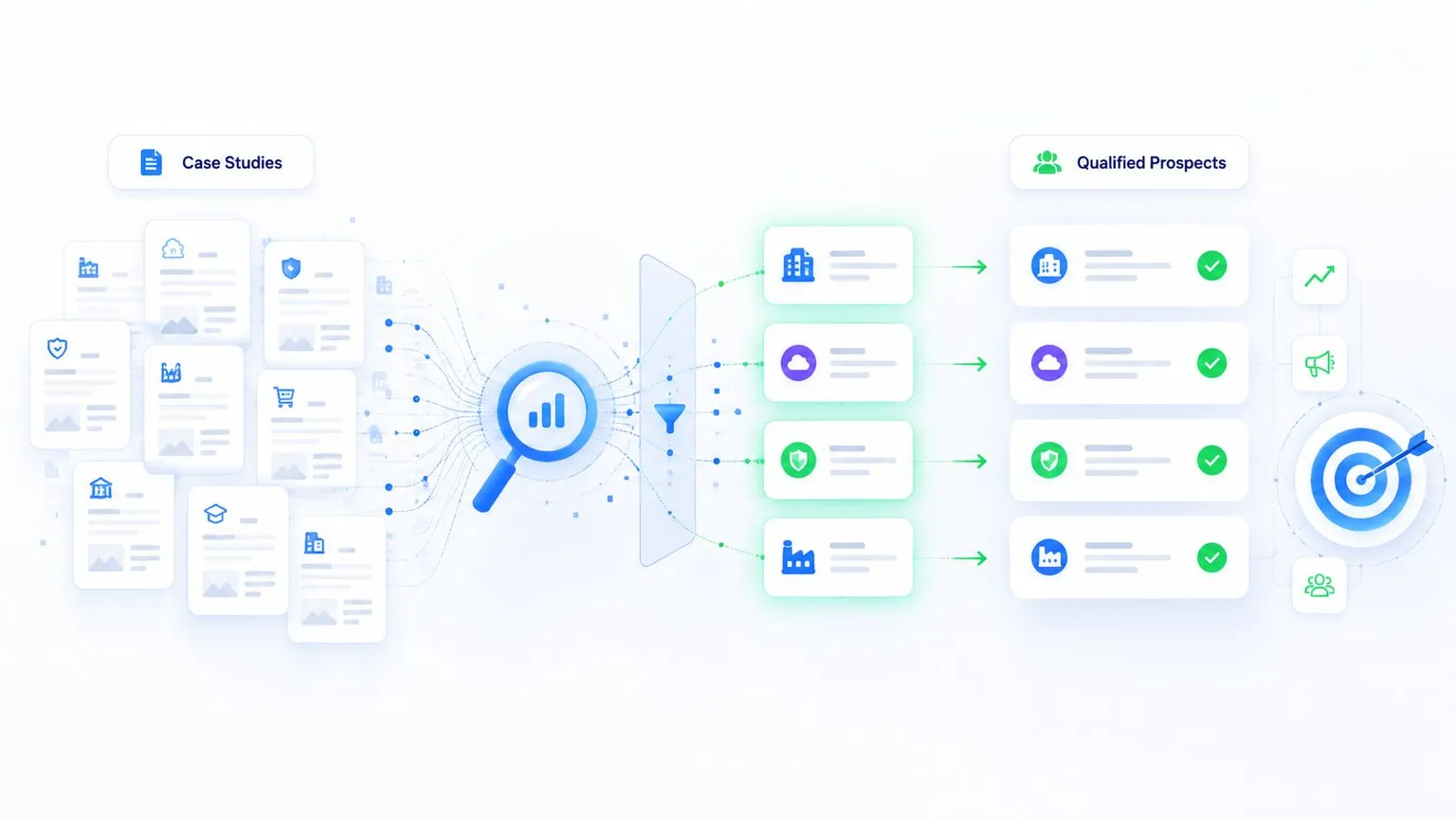 A competitor's public case study is not just marketing copy. It's a buying signal disguised as content.
Every company featured in a competitor's case study went through a complete buying journey - problem identification, vendor evaluation, contract, implementation, measurable results. They understand the category. They've been through the pain. They had budget.
How to use it: Go into any category on casestudies.com (CRM, cybersecurity, AP automation, compliance, AI sales tools). Find vendors with 20+ case studies. Pull the company names featured in those stories. You now have a list of companies that are pre-educated on the problem your product solves.
Your outbound angle changes completely. Instead of:
"Do you need help with X?"
You write:
"Looks like you already invested in X with [vendor]. Most teams hit Y problems right after that phase - are you dealing with that yet?"
You're not pitching. You're entering a conversation that's already in progress.
2. Build Lookalike Lists from Actual Buyers - Not Guesses
 Most ICP definitions are built from hypotheses. "We think our best customers are mid-market SaaS companies with 200–500 employees." That's a guess.
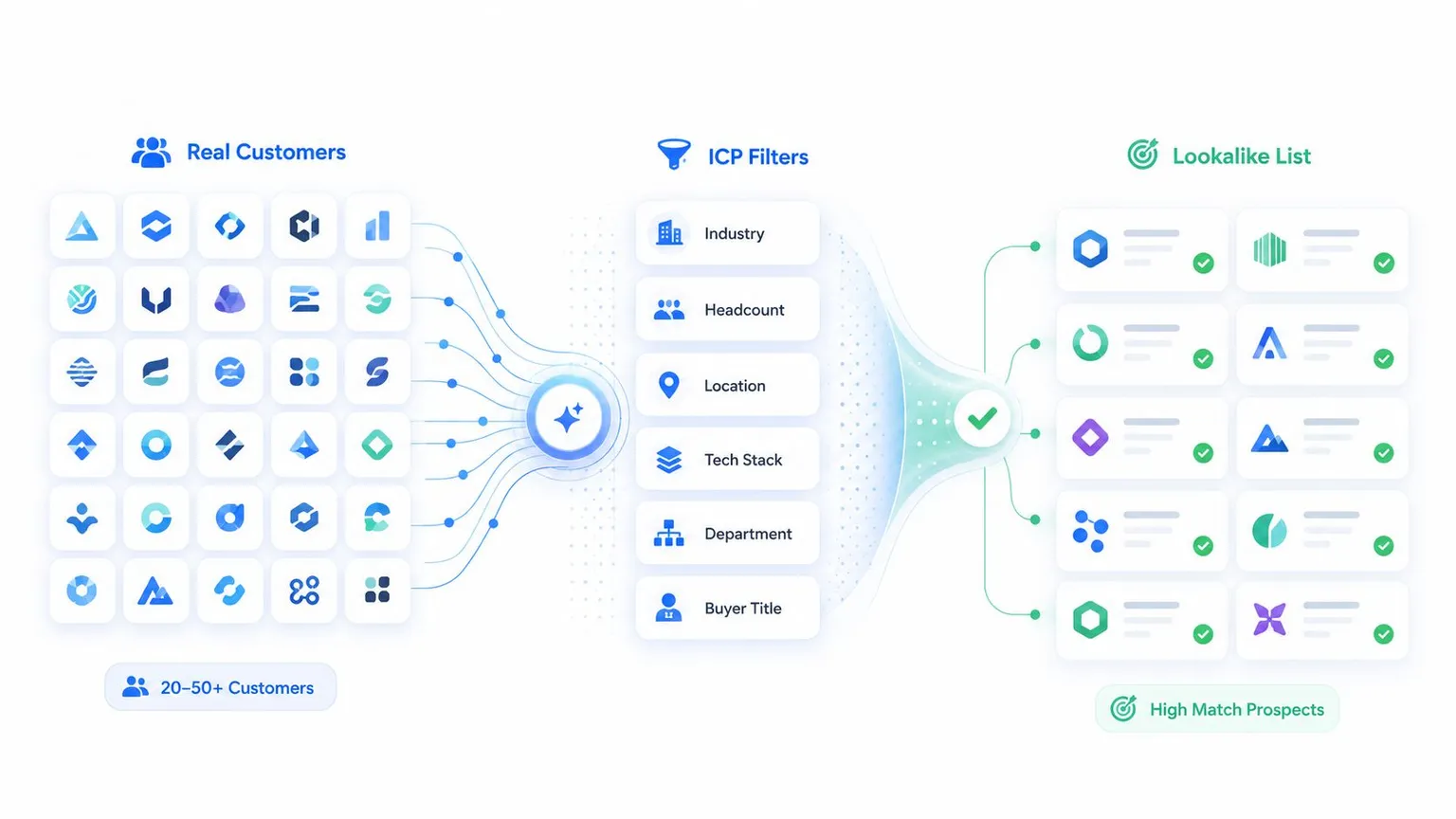
A vendor's case study roster is a published list of their actual best customers. You can reverse-engineer it.
How to use it: Take 20–50 companies from a vendor's case study collection. Enrich each one by:
- Industry and sub-industry
- Employee count and growth stage
- Geography and number of locations
- Tech stack (Clearbit, BuiltWith)
- Department structure (are they finance-heavy? ops-heavy?)
- Job titles mentioned in the case study
Now find similar companies using LinkedIn Sales Navigator, Clay, or Apollo filters built from those attributes.
Example: You find 12 mid-market healthcare companies featured in a compliance software vendor's case studies. They're all between 150–400 employees, US-based, with dedicated compliance or legal teams. You now build a list of healthcare companies with matching profiles who haven't bought that solution yet.
Your copy is sharper because you didn't invent the pain. The market showed it to you.
3. Target Companies Sitting on Underused Proof
A large number of B2B companies publish case studies once, share them once on LinkedIn, and then forget about them entirely. The proof sits on the website. No campaigns. No outbound angles. No LinkedIn ads. No SDR talk tracks.
That's an opportunity for agencies.
How to use it: Filter casestudies.com for companies with 10, 20, or 50+ case studies in a given category. These are companies with strong social proof that aren't using it to its full commercial potential.
Your pitch: "You have 30+ customer stories on your website and on casestudies.com. That's 30 sales angles you're not using in outbound or paid campaigns. We turn existing customer proof into pipeline."
That's a sharper value proposition than "we do content marketing" - because it starts with their asset, not your service.
4. Sell the Proof Distribution Offer
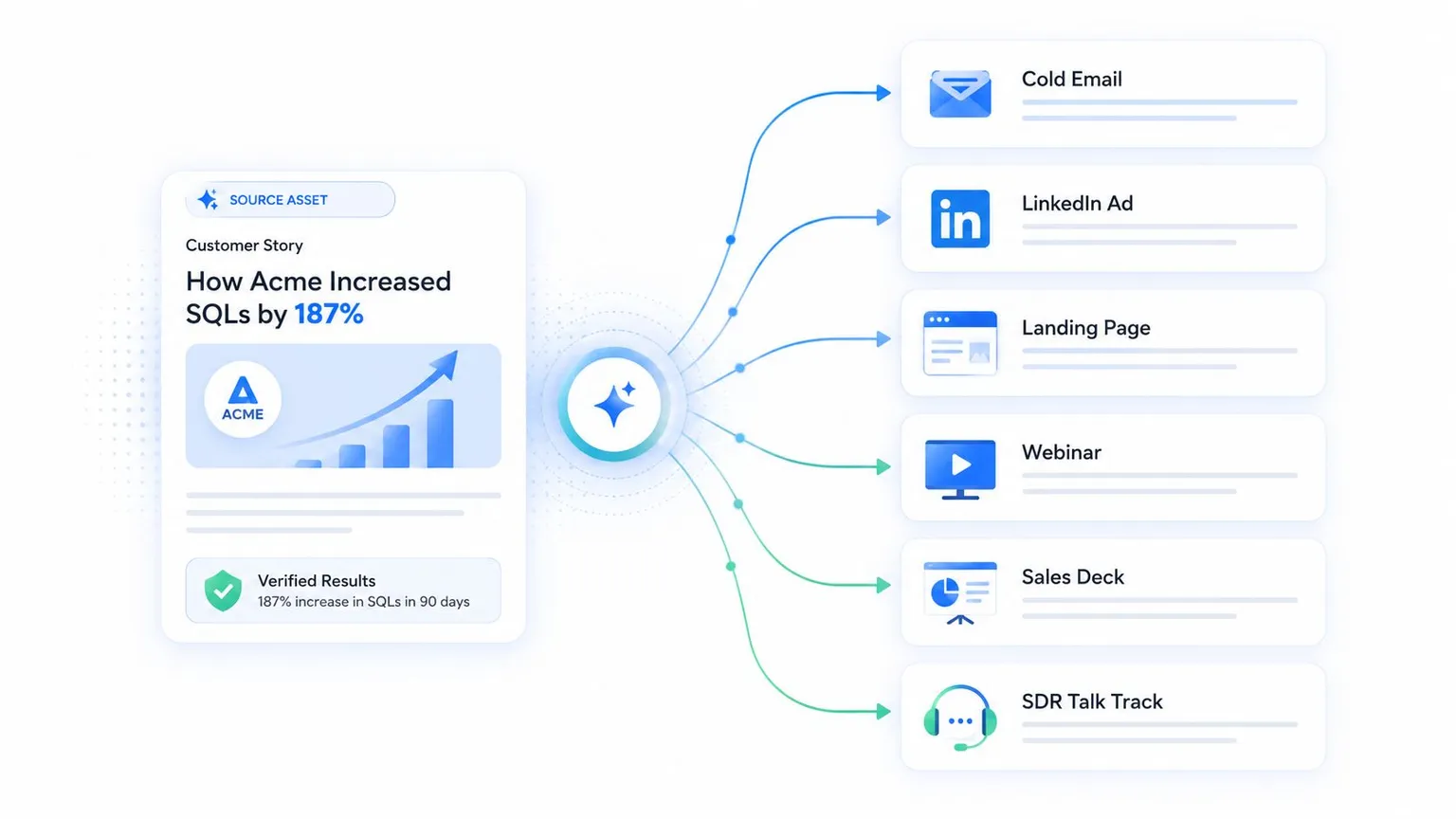 Most companies don't need more content. They need better distribution of the proof they already have. One case study is actually 8–10 campaign assets.
A single case study can become:
| Asset Type | Use Case |
|---|---|
| Cold email angle | Personalized opening line targeting similar companies |
| LinkedIn ad | Proof-based ad creative for retargeting or lookalikes |
| Industry landing page | "How [Company] in [Industry] solved X" |
| Founder LinkedIn post | First-person storytelling with specific numbers |
| SDR talk track | Objection-handling based on actual buyer outcome |
| Retargeting angle | "Companies like [Customer] use us to..." |
| Webinar hook | "We'll show how [Customer] went from X to Y" |
| Sales deck slide | Third-party proof in the proposal stage |
If an agency built its entire offer around "give us your existing case studies and we'll turn them into pipeline assets," that's a clean, specific, defensible proposition - especially in categories where competitors have 80 case studies and clients have 3.
5. Write Outbound Emails in the Buyer's Actual Language
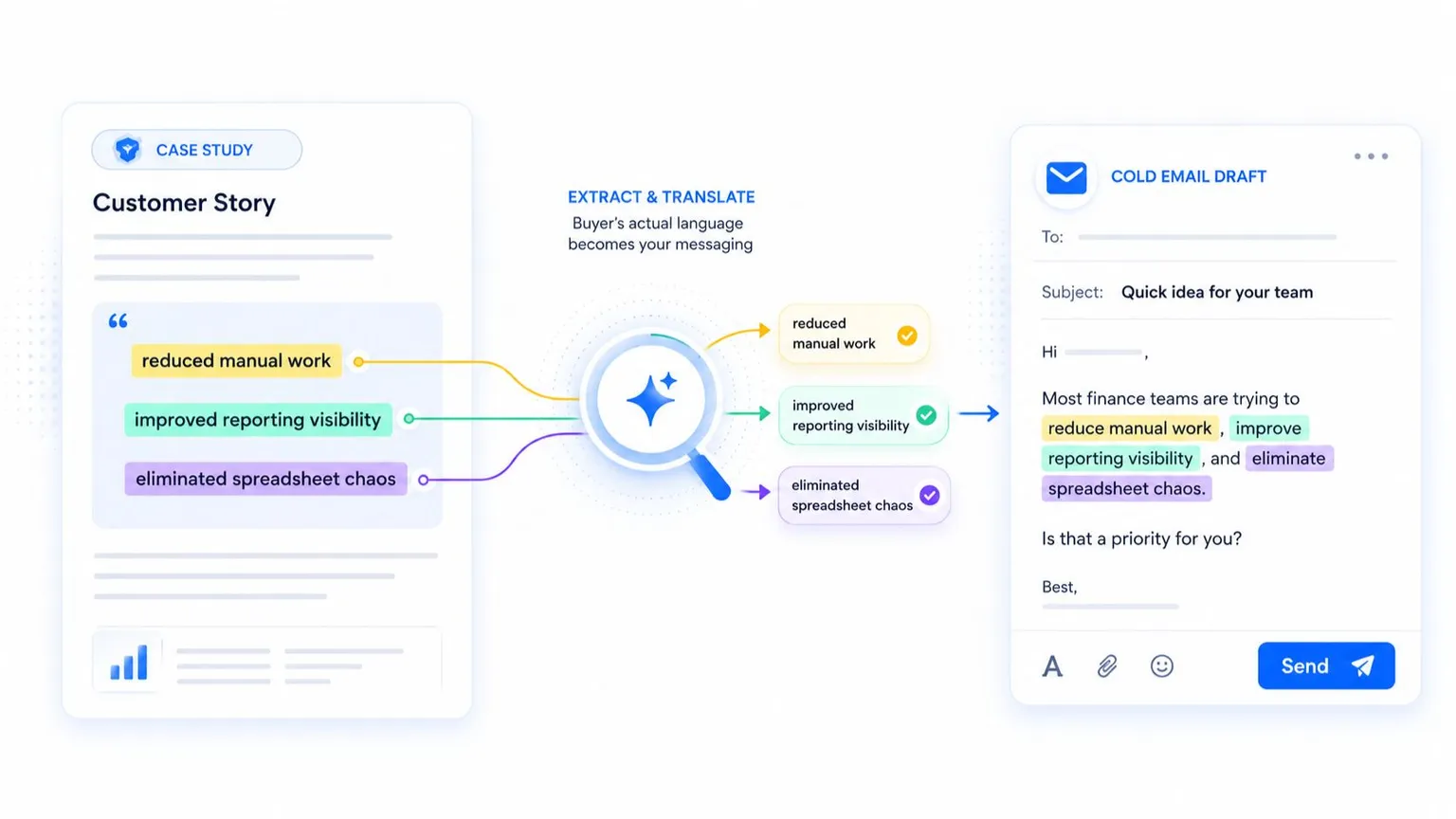 This is the tactic most people skip entirely.
Case studies are written in buyer language. Not vendor language. Not marketing-speak. The actual phrases buyers use to describe their problems before and after a purchase.
Common phrases that surface in B2B case studies:
- "reduced manual work across the finance team"
- "improved reporting visibility for the executive team"
- "simplified compliance across multiple jurisdictions"
- "faster onboarding for new hires"
- "centralized operations across 12 locations"
- "eliminated spreadsheet chaos in AP"
- "improved audit readiness before our Series B"
- "better customer response times without hiring more headcount"
That language was not invented. It came from real buyers describing real situations.
How to use it: Scrape 30–50 case study titles and summaries from a category. Run them through an AI prompt to extract: repeated pain points, common outcomes, buyer titles, department-specific language, and before/after situations.
Now write your cold email using that extracted vocabulary. Instead of:
"We help optimize operational efficiency across your organization."
You write:
"Most finance teams I talk to in healthcare are trying to get out of spreadsheet-heavy AP reporting without touching their ERP configuration. Is that on your radar?"
That second version sounds like a conversation. Because it started with language the buyer already uses internally.
6. Find the Department That Actually Owns the Budget
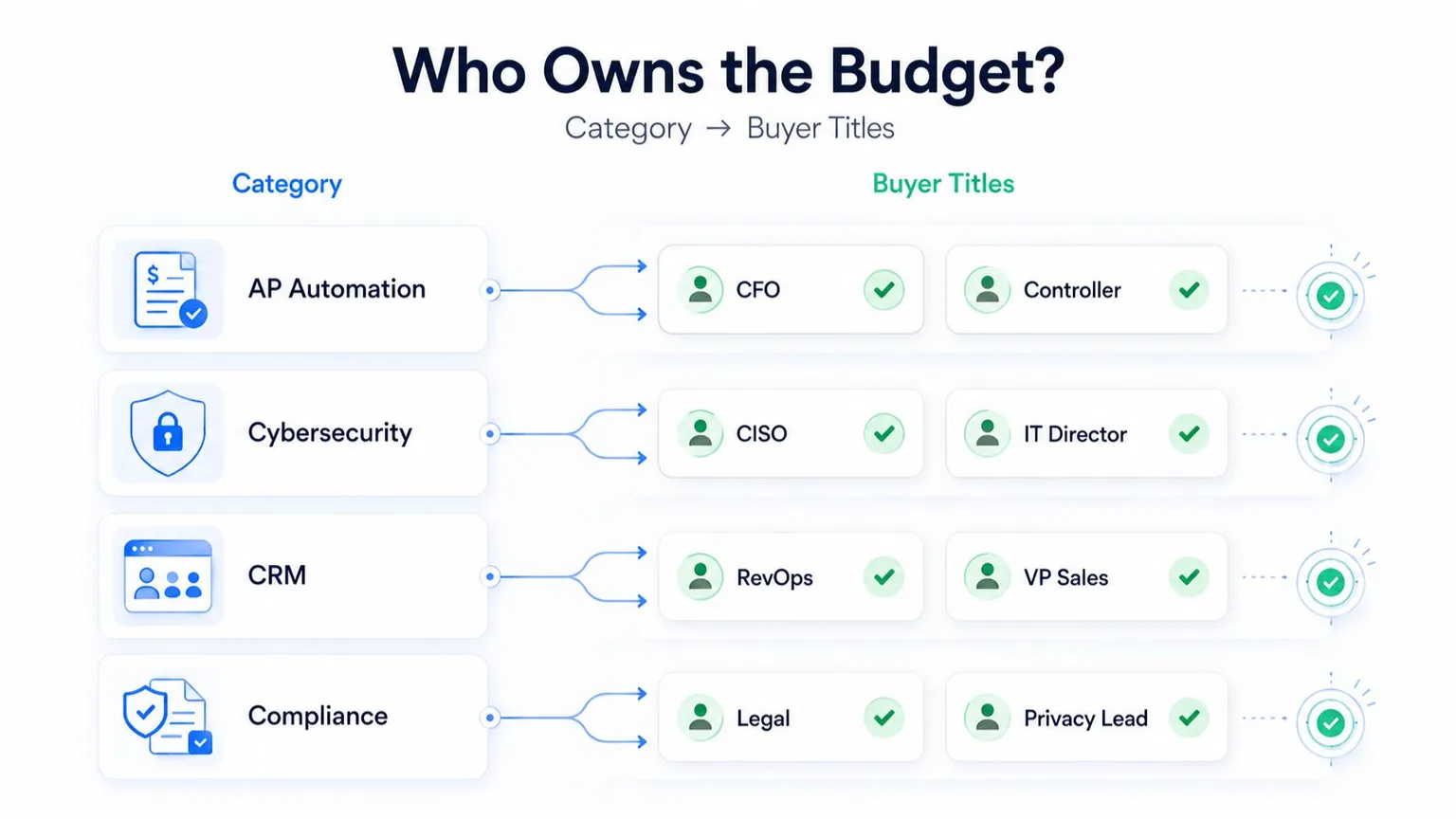 Case studies frequently mention the buyer's title - the person who championed the purchase, led the implementation, or provided the testimonial quote.
That title tells you exactly who to target in similar companies.
Examples of what case studies reveal by category:
| Category | Buyer Titles Surfacing in Case Studies |
|---|---|
| AP Automation | CFO, Controller, Accounting Ops Lead, VP Finance |
| GDPR/Compliance | Legal Counsel, Compliance Officer, HR Director, Privacy Lead |
| CRM Implementation | Sales Ops, RevOps, VP Sales, Marketing Ops |
| Cybersecurity | CISO, IT Director, VP Engineering, Head of Security |
| Customer Support Software | Head of CS, Customer Success Director, VP Support |
| AI Sales Tools | Head of Sales, RevOps, VP Sales, SDR Manager |
| ERP | COO, Head of Operations, IT Director, Finance Director |
This replaces guesswork in your Apollo filters. Stop filtering by job title based on what you think makes sense and start filtering by what the actual buyers looked like when deals closed.
7. Build Competitor Displacement Campaigns (Without Being Aggressive)
A company featured in a competitor's case study is not cold. But the approach matters.
The wrong move is going in with "are you happy with your current vendor?" That's the oldest, most tired cold email opener in B2B.
The better angle is the adjacent problem. The case study tells you what they solved. Your pitch is about what comes next.
"Saw you've been using [Vendor] for [X]. Most teams that solve X start running into Y within the next 6–12 months - usually once the [specific workflow] scales past a certain point. Is that on your list?"
You're not challenging their decision. You're extending the conversation into the next problem. This works especially well when your product solves a downstream problem from what the competitor's case study covers.
8. Find the Vendor Proof Gap in Your Category
In any category on casestudies.com, some vendors have 80+ customer stories and some have 3. That asymmetry creates two different outbound angles.
For companies with lots of case studies:
"You have strong proof - but from what I can tell, it's mostly sitting on casestudies.com and your website. We help teams turn that proof into outbound campaigns and paid creatives that start conversations with similar companies."
For companies with minimal case studies:
"Your competitors in [Category] have 30–80 public customer stories, which makes them look like the safer choice before your sales team even gets involved. We help close that credibility gap."
Services you can pitch into both situations:
- Case study production and video testimonials
- Customer story repurposing (email, LinkedIn, landing page)
- Review generation (G2, Capterra, TrustRadius)
- Proof-led landing pages by industry or segment
- Case study SEO - optimizing existing stories for search
- SDR talk tracks built from customer proof
- Sales enablement assets anchored in real outcomes
This tactic is particularly sharp for content agencies, LinkedIn agencies, video agencies, and demand gen consultants targeting B2B SaaS vendors.
9. Map Entire B2B Categories to Find the Best Markets to Target
The category pages on casestudies.com are effectively market maps. You can see which B2B categories have the most customer proof, which vendors dominate, and which verticals have the highest proof density - all in one view.
The best categories for outbound share these characteristics:
- High deal sizes (above $10K ACV)
- Complex sales cycles with multiple stakeholders
- Strong need for third-party proof before purchase
- Painful implementation that creates lock-in (and competitive displacement opportunities)
- Multiple active vendors creating competitive dynamics
- High cost of switching (meaning existing customers are valuable to displace or expand)
High-value categories based on these criteria:
Cybersecurity · Compliance · AP Automation · ERP · CRM · Cloud Consulting · AI Implementation · Business Process Automation · Procurement Software · Customer Support Platforms
These categories are significantly better targets than low-ACV tooling with no urgency. The proof density on casestudies.com reflects the buying intensity - categories with hundreds of case studies are categories where companies routinely write checks.
One Critical Step Before You Send: Verify Every Email on Your List
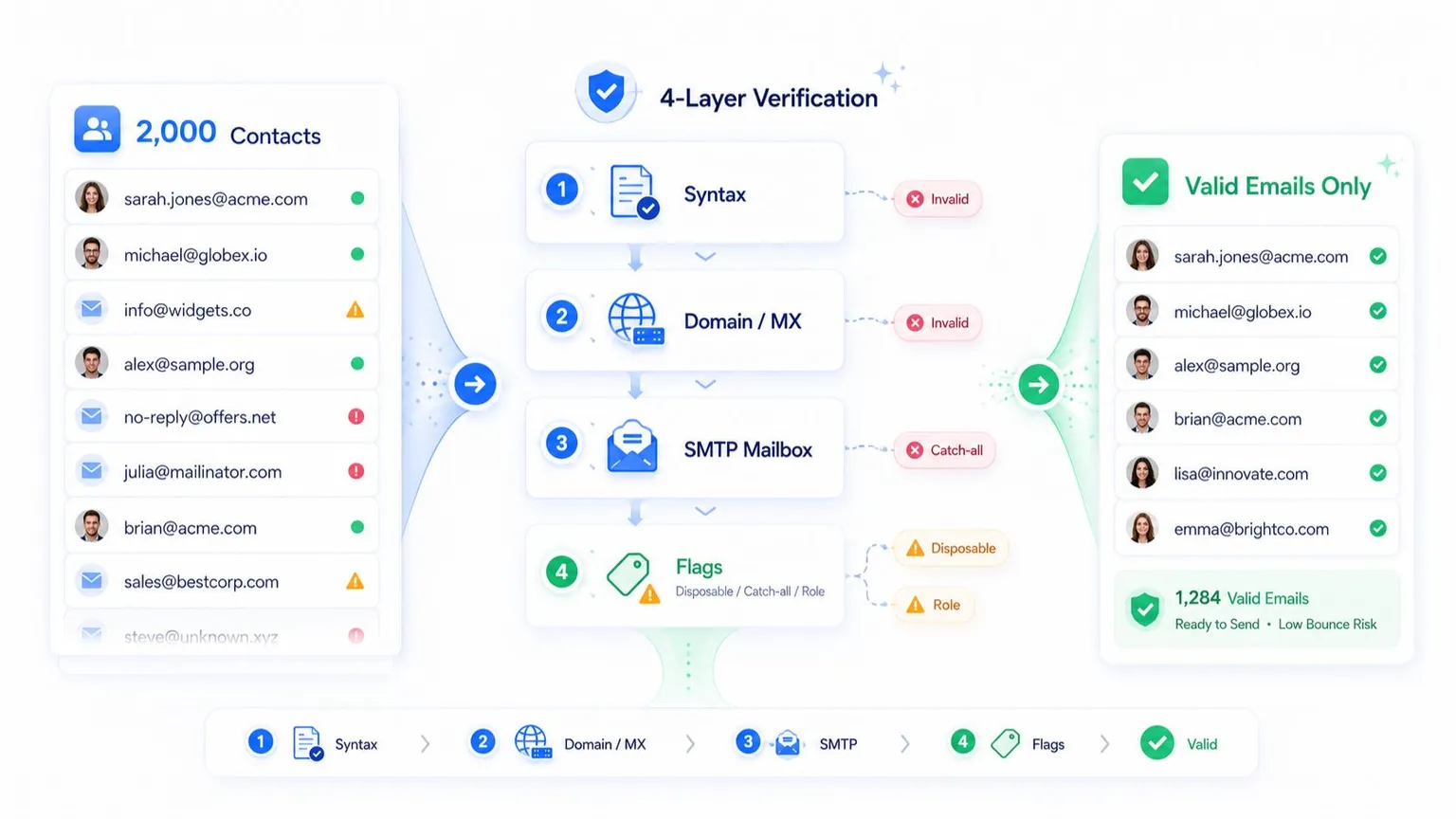 You've done the hard work. You've pulled companies from competitor case studies, enriched them against real buyer attributes, written emails in buyer language, and targeted the right titles based on who actually owns the budget.
Now you're about to build your send list by finding contact emails for every company on your list.
Here's where most outbound teams throw it all away.
They build 500 or 2,000 contacts from tools like Apollo, Hunter, or Clay - tools that aggregate email addresses from crawled sources that can be months or years old. Then they send without verifying. Bounce rates go to 5%, 10%, 15%. ISPs flag the domain. Deliverability collapses. The thoughtful list-building work gets burned in a bad send.
The 2% bounce rate rule: ISPs including Gmail and Outlook monitor sender bounce rates continuously. Exceeding 2% triggers spam filtering, temporary blocks, and - at sustained levels - domain blacklisting. A bad send doesn't just waste one campaign. It can poison your domain's reputation for every email you send for months afterward.
The fix is straightforward: verify every email before it goes into your send queue.
MailValid runs a four-layer check on every address:
- Syntax validation - RFC 5322 format check
- Domain and MX record verification - confirms the domain has active mail exchange records
- SMTP mailbox verification - confirms the specific mailbox accepts mail, without sending an email
- Enrichment flags - disposable, catch-all, role-based, and free provider detection
At $0.001 per email, verifying a 2,000-contact list costs $2. Verifying a 10,000-contact list costs $10. That's the cost of protecting a campaign you just spent hours building.
import requests

API_KEY = "mv_live_your_key"

emails = ["contact@company.com", "founder@startup.io", ...] # your enriched list

resp = requests.post(
    "https://mailvalid.io/api/v1/verify/bulk",
    headers={"X-API-Key": API_KEY, "Content-Type": "application/json"},
    json={"emails": emails}
)

print(resp.json())

# Returns: status (valid/invalid/catch-all), is_disposable, is_role, is_catch_all
Send only to status: valid addresses. Suppress invalid and is_disposable: true. Flag catch-all addresses for a separate low-volume test send.
This one step separates outbound teams that protect their domain long-term from those that burn it on a single bad campaign.
Frequently Asked Questions
What is casestudies.com and how does it work for outbound prospecting?
CaseStudies.com is a public database of 900,000+ verified B2B customer case studies from companies across SaaS, healthcare, finance, cybersecurity, compliance, and other categories. For outbound prospecting, it functions as a database of companies that have already gone through a complete buying cycle in a given category - they identified a problem, allocated budget, purchased a solution, and publicly approved the vendor's use of their name. This makes them higher-intent targets than cold contact lists scraped from generic company databases.
How do you find high-intent B2B prospects from case studies?
To find high-intent B2B prospects from case studies:
(1) search casestudies.com by category (e.g., cybersecurity, AP automation, CRM);
(2) identify vendors with 20+ customer stories;
(3) extract the company names featured in those stories;
(4) enrich each company by industry, size, tech stack, and buyer titles mentioned;
(5) build a lookalike list of similar companies that haven't yet purchased; and (6) verify email addresses before sending outbound campaigns.
What is buyer intent in outbound sales?
Buyer intent in outbound sales refers to signals that indicate a company is likely to purchase a solution in a given category. High-intent signals include: appearing in a competitor's case study (proven past purchase), job postings for roles that use your product type, recent funding rounds, technology adoption signals, and category-specific search behavior. Public case studies represent one of the strongest intent signals available because they confirm an actual completed purchase, not just research behavior.
Why should you verify email addresses before outbound campaigns?
You should verify email addresses before outbound campaigns to protect your sender reputation and domain health. ISPs flag senders whose bounce rate exceeds 2%, and contact databases from tools like Apollo or Hunter can contain 5–20% stale or invalid addresses depending on how recently they were collected. A single high-bounce campaign can trigger spam filtering or domain blacklisting that persists for months. Email verification services like MailValid confirm address validity before you send, keeping bounce rates below the 2% threshold.
What is the best source of high-intent B2B prospect lists?
The best sources of high-intent B2B prospect lists combine demonstrated purchase behavior with verified contact data. Effective sources include: competitor case study databases (like casestudies.com), job postings that signal active investment in a category, G2 and Capterra reviewer lists, LinkedIn connections of recently hired role-specific executives, and companies that have just raised funding in your target vertical. In all cases, email addresses sourced from these signals should be verified before sending using SMTP-level tools like MailValid.
How does email list verification improve outbound reply rates?
Email list verification improves outbound reply rates indirectly by protecting deliverability. When invalid emails are removed before sending, bounce rates stay below 2%, ISPs continue routing mail to the inbox instead of spam, and more of your emails are seen by real people. A message that never lands in the inbox has a 0% reply rate regardless of copy quality. Verification ensures your thoughtful prospecting work reaches its target.
What outbound email categories have the best response rates?
Based on case study density and deal complexity, the B2B categories with the strongest outbound response rates tend to involve high-ACV purchases with multi-stakeholder buying processes: cybersecurity, ERP, AP automation, compliance software, CRM implementation, AI sales tooling, and business process automation. In these categories, prospects are familiar with the problem, have budget allocated or allocatable, and are more receptive to specific, research-backed outbound than generic cold emails.
Start With Better Signals. Protect Your Domain. Send With Confidence.
The gap between outbound teams that build pipelines and those that burn domains comes down to two things: the quality of the list and the health of the emails on it.
CaseStudies.com solves the first problem. It gives you a database of companies that have already demonstrated buying behavior in the categories you care about - for free, no login required.
MailValid solves the second problem. It verifies every email on your enriched list before you send, so your domain stays healthy, your deliverability stays strong, and the work you put into building intent-based lists isn't wasted on a bounce-triggered spam flag.
Explore MailValid Alternatives
→ Start with 100 free verification credits - no credit card required
→ View bulk verification pricing for outbound lists
*Last updated: June 2026. casestudies.com database size (902,504+ case studies) sourced from casestudies.com homepage as of June 2026.
MailValid Team
Email verification experts
Join teams that verify before they send
Stop letting bad emails hurt your deliverability
100 free credits. From $0.00075/email after. Credits never expire. No credit card required.