Blog / Technical Guide

Email Verification API Retries and Circuit Breakers: Building Resilient Systems

Email Verification API Retries and Circuit Breakers: Building Resilient Systems

Your email verification API just went down at 2 AM, and your registration pipeline is silently dropping users. Without retry logic and circuit breakers, a single API timeout cascades into a full system failure — costing you customers, revenue, and sender reputation.


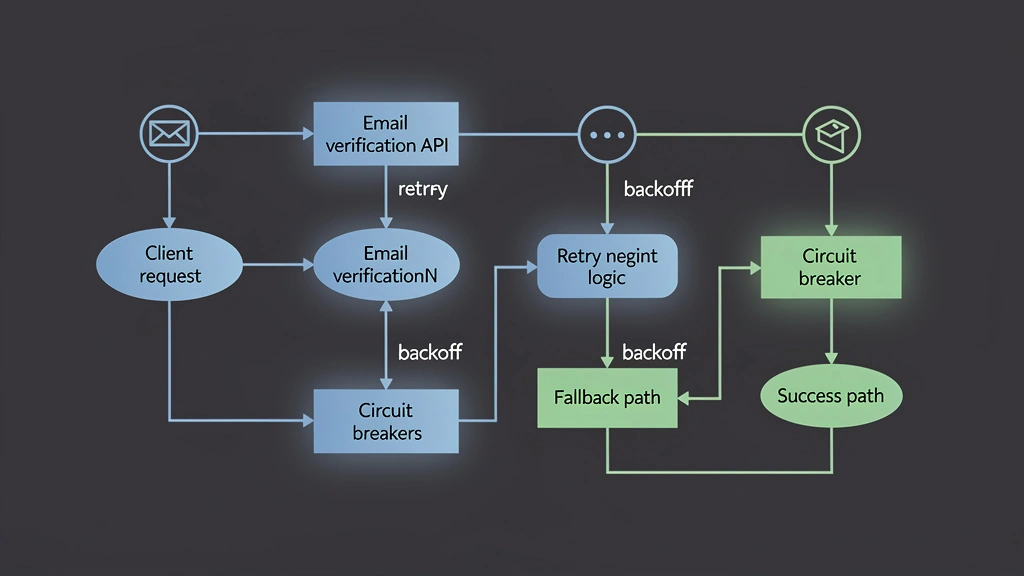
Diagram illustrating key concept

Why Email Verification API Resilience Is a Production-Critical Problem

Most engineering teams treat email verification as a simple HTTP call. They write requests.post(url, json=payload), check the status code, and move on. This works fine in staging environments with perfect network conditions and a healthy API. It catastrophically fails in production.

According to Validity's 2023 Email Deliverability Report, invalid email addresses account for up to 20% of all email addresses collected through web forms, and bounce rates above 2% can permanently damage your sender reputation with major ISPs. That means email verification isn't optional — it's a core reliability requirement for any system that sends transactional or marketing email.

But here's the problem engineers rarely discuss: the verification infrastructure itself can fail. DNS resolvers time out. SMTP handshakes stall. Third-party verification APIs experience outages. Network partitions happen. When your email verification API is unavailable, you have a choice: fail the entire registration flow, or build a system resilient enough to handle degradation gracefully.

This guide covers the engineering patterns that make email verification pipelines production-ready: exponential backoff with jitter, circuit breaker patterns, dead letter queue strategies, and graceful degradation to syntax-only validation. These aren't theoretical concepts — they're battle-tested patterns used by teams processing millions of verification requests per day.

The stakes are real. According to HubSpot's Email Marketing Statistics report, email marketing delivers an average ROI of $36 for every $1 spent. Protecting the integrity of your email list — and the reliability of the system that validates it — is one of the highest-leverage engineering investments you can make.


Understanding What Can Go Wrong: Failure Modes in Email Verification

Before you can build resilience, you need to understand exactly what you're defending against. Email verification is not a single operation — it's a pipeline of distinct checks, each with its own failure characteristics.

The Verification Pipeline and Its Weak Points

A full email verification check involves multiple layers:

Syntax validation checks whether the address conforms to RFC 5321 (SMTP) and RFC 5322 (Internet Message Format) standards. This is purely local computation and cannot fail due to network issues.

DNS MX record lookup queries the DNS system to determine whether the domain has mail exchange records. According to RFC 5321, Section 5.1, an SMTP client must look up the MX record for the domain before attempting delivery. DNS lookups can time out, return SERVFAIL responses, or produce inconsistent results during DNS propagation events.

SMTP handshake verification opens a connection to the mail server and simulates the beginning of an email delivery conversation. This is where most failures occur. The remote SMTP server may be rate-limiting your IP, the connection may time out, or the server may return a temporary error.

Disposable and role-based account detection queries internal or third-party databases of known throwaway email providers and role-based prefixes (admin@, info@, noreply@). These lookups add latency and introduce additional external dependencies.

SPF, DKIM, and DMARC record analysis checks the domain's authentication configuration. SPF is defined in RFC 7208, DKIM in RFC 6376, and DMARC in RFC 7489. Analyzing these records helps assess the domain's overall email health but requires additional DNS queries.

Each of these steps can fail independently. A resilient system must handle failures at every layer.

SMTP Response Codes You Must Understand

When your verification system communicates with remote SMTP servers, the server responds with standardized codes defined in RFC 5321 and extended status codes defined in RFC 3463. Understanding these codes is essential for building intelligent retry logic.

421 Service Not Available — The server is temporarily unavailable. This is a transient error and should always trigger a retry with backoff. The server is telling you explicitly: "Try again later."

450 Requested Mail Action Not Taken — A temporary failure, often related to the mailbox being temporarily unavailable or the server being busy. Retry-eligible.

451 Requested Action Aborted — A local error in processing. Often seen when the remote server is experiencing internal issues. Retry-eligible.

550 Requested Action Not Taken: Mailbox Unavailable — The email address does not exist. This is a permanent failure and should never be retried. Mark the address as invalid and move on.

551 User Not Local — The server is redirecting you to another address. Not a verification failure per se, but requires special handling.

552 Requested Mail Action Aborted: Exceeded Storage — The mailbox is full. The address likely exists but cannot receive mail. Treat as a temporary condition.

553 Requested Action Not Taken: Mailbox Name Not Allowed — The address format is invalid according to the remote server. Treat as permanent.

5xx codes are permanent failures. 4xx codes are temporary failures. Your retry logic must respect this distinction — retrying a 550 response wastes resources and can get your IP blacklisted.


Exponential Backoff with Jitter: The Right Way to Retry

Naive retry logic — retrying immediately on failure, or retrying at fixed intervals — is worse than no retry logic in many situations. When a verification API is under load, a thundering herd of synchronized retries can amplify the problem and turn a brief degradation into a full outage.

Why Naive Retries Fail

Imagine 10,000 concurrent users registering on your platform. Each registration triggers an email verification call. The verification API experiences a 5-second hiccup. All 10,000 requests fail simultaneously. If every client retries after exactly 1 second, you now send 10,000 requests to an API that just recovered — potentially overwhelming it again. This is the thundering herd problem, and it's a well-documented failure pattern in distributed systems.

The solution is exponential backoff with jitter: each retry waits for an exponentially increasing delay, plus a random jitter value that desynchronizes retries across clients.

The formula for the wait time before retry n is:

wait = min(cap, base * 2^n) + random(0, jitter_max)

Where cap is the maximum wait time, base is the initial wait, and jitter_max is the maximum random offset.

Production-Ready Retry Implementation in Python

Here is a production-grade implementation using the MailValid API with proper retry logic, timeout handling, and response-code-aware retry decisions:

import requests
import time
import random
import logging
from typing import Optional, Dict, Any
from dataclasses import dataclass
from enum import Enum

logger = logging.getLogger(__name__)

class VerificationResult(Enum):
    VALID = "valid"
    INVALID = "invalid"
    UNKNOWN = "unknown"
    DEGRADED = "degraded"  # Syntax-only result during API outage

@dataclass
class EmailVerificationResponse:
    email: str
    result: VerificationResult
    score: Optional[float]
    is_disposable: Optional[bool]
    is_role_based: Optional[bool]
    smtp_response_code: Optional[int]
    source: str  # "api", "cache", "syntax_only"
    raw_response: Optional[Dict[str, Any]]

class RetryConfig:
    def __init__(
        self,
        max_retries: int = 3,
        base_delay: float = 0.5,
        max_delay: float = 30.0,
        jitter_max: float = 1.0,
        retry_on_status_codes: tuple = (429, 500, 502, 503, 504),
        timeout: float = 10.0,
    ):
        self.max_retries = max_retries
        self.base_delay = base_delay
        self.max_delay = max_delay
        self.jitter_max = jitter_max
        self.retry_on_status_codes = retry_on_status_codes
        self.timeout = timeout

def calculate_backoff(attempt: int, config: RetryConfig) -> float:
    """
    Calculate exponential backoff with full jitter.
    Uses the 'full jitter' algorithm recommended by AWS for distributed systems.
    """
    exponential_delay = config.base_delay * (2 ** attempt)
    capped_delay = min(config.max_delay, exponential_delay)
    # Full jitter: random value between 0 and the capped delay
    jitter = random.uniform(0, min(capped_delay, config.jitter_max))
    return capped_delay + jitter

def is_retryable_smtp_code(smtp_code: Optional[int]) -> bool:
    """
    Determine if an SMTP response code indicates a transient failure.
    4xx codes are transient (RFC 5321). 5xx codes are permanent.
    """
    if smtp_code is None:
        return True  # Unknown — assume transient
    return 400 <= smtp_code < 500

def verify_email_with_retry(
    email: str,
    api_key: str,
    config: Optional[RetryConfig] = None,
) -> EmailVerificationResponse:
    """
    Verify an email address using MailValid API with exponential backoff retry logic.
    Handles transient failures gracefully and respects SMTP response semantics.
    """
    if config is None:
        config = RetryConfig()

    last_exception = None
    last_status_code = None

    for attempt in range(config.max_retries + 1):
        try:
            response = requests.post(
                "https://mailvalid.io/api/v1/verify",
                headers={"X-API-Key": "mv_live_key"},
                json={"email": email},
                timeout=config.timeout,
            )

            # Success path
            if response.status_code == 200:
                result = response.json()
                smtp_code = result.get("smtp_response_code")

                # If SMTP returned a permanent failure, don't retry
                if smtp_code and smtp_code >= 500:
                    logger.info(
                        f"Permanent SMTP failure for {email}: {smtp_code}"
                    )
                    return EmailVerificationResponse(
                        email=email,
                        result=VerificationResult.INVALID,
                        score=result.get("score"),
                        is_disposable=result.get("is_disposable"),
                        is_role_based=result.get("is_role_based"),
                        smtp_response_code=smtp_code,
                        source="api",
                        raw_response=result,
                    )

                return EmailVerificationResponse(
                    email=email,
                    result=VerificationResult(result.get("result", "unknown")),
                    score=result.get("score"),
                    is_disposable=result.get("is_disposable"),
                    is_role_based=result.get("is_role_based"),
                    smtp_response_code=smtp_code,
                    source="api",
                    raw_response=result,
                )

            # Permanent client error — do not retry
            if response.status_code in (400, 401, 403, 422):
                logger.error(
                    f"Non-retryable error {response.status_code} for {email}"
                )
                raise ValueError(
                    f"API returned non-retryable status: {response.status_code}"
                )

            # Transient server error — retry if attempts remain
            last_status_code = response.status_code
            if response.status_code not in config.retry_on_status_codes:
                raise ValueError(
                    f"Unexpected status code: {response.status_code}"
                )

            logger.warning(
                f"Transient error {response.status_code} for {email}, "
                f"attempt {attempt + 1}/{config.max_retries + 1}"
            )

        except requests.Timeout as e:
            last_exception = e
            logger.warning(
                f"Timeout on attempt {attempt + 1} for {email}: {e}"
            )
        except requests.ConnectionError as e:
            last_exception = e
            logger.warning(
                f"Connection error on attempt {attempt + 1} for {email}: {e}"
            )
        except ValueError:
            raise  # Non-retryable errors propagate immediately

        # Don't sleep after the last attempt
        if attempt < config.max_retries:
            delay = calculate_backoff(attempt, config)
            logger.info(f"Retrying in {delay:.2f}s (attempt {attempt + 2})")
            time.sleep(delay)

    # All retries exhausted
    logger.error(
        f"All {config.max_retries + 1} attempts failed for {email}. "
        f"Last status: {last_status_code}, Last exception: {last_exception}"
    )
    raise RuntimeError(
        f"Email verification failed after {config.max_retries + 1} attempts"
    )

This implementation handles the key production concerns: timeout configuration, response-code-aware retry decisions, full jitter backoff, and proper logging for observability.

Configuring Timeouts Correctly

A frequently overlooked detail: always set both a connection timeout and a read timeout. The requests library in Python accepts a tuple (connect_timeout, read_timeout). For email verification APIs, SMTP handshakes can take several seconds, so a read timeout of 10-15 seconds is reasonable. Never use timeout=None in production.

# Correct: separate connect and read timeouts
response = requests.post(url, timeout=(3.0, 12.0))

# Risky: single timeout applies to the entire request
response = requests.post(url, timeout=10.0)

Circuit Breaker Pattern: Preventing Cascade Failures

Retry logic alone is insufficient. If your verification API is down for an extended period, retrying every request wastes resources, degrades user experience, and can contribute to the API's recovery burden. The circuit breaker pattern solves this by tracking failure rates and temporarily stopping requests to a failing service.

How the Circuit Breaker Works

The circuit breaker has three states:

Closed (normal operation): Requests flow through normally. The breaker tracks failures. If failures exceed a threshold within a time window, the breaker trips to Open.

Open (failure mode): All requests fail immediately without attempting the actual API call. After a configured timeout, the breaker moves to Half-Open.

Half-Open (recovery probe): A limited number of test requests are allowed through. If they succeed, the breaker closes. If they fail, it returns to Open.

This pattern was popularized by Michael Nygard in Release It! and has become a foundational pattern in resilient distributed systems. Netflix's Hystrix library brought it to mainstream adoption, and it's now implemented in virtually every major service mesh.

Production Circuit Breaker Implementation

import threading
import time
from enum import Enum
from typing import Callable, Optional, Any
from dataclasses import dataclass, field
import logging

logger = logging.getLogger(__name__)

class CircuitState(Enum):
    CLOSED = "closed"
    OPEN = "open"
    HALF_OPEN = "half_open"

@dataclass
class CircuitBreakerConfig:
    failure_threshold: int = 5          # Failures before opening
    recovery_timeout: float = 60.0     # Seconds before attempting recovery
    half_open_max_calls: int = 3        # Test calls in half-open state
    success_threshold: int = 2          # Successes needed to close from half-open
    window_size: float = 60.0          # Rolling window for failure counting (seconds)

class CircuitBreakerOpenError(Exception):
    """Raised when a call is attempted on an open circuit breaker."""
    pass

class CircuitBreaker:
    """
    Thread-safe circuit breaker implementation for email verification API calls.
    Implements the standard three-state pattern: Closed, Open, Half-Open.
    """

    def __init__(self, name: str, config: Optional[CircuitBreakerConfig] = None):
        self.name = name
        self.config = config or CircuitBreakerConfig()
        self._state = CircuitState.CLOSED
        self._failure_count = 0
        self._success_count = 0
        self._last_failure_time: Optional[float] = None
        self._half_open_calls = 0
        self._lock = threading.RLock()
        self._failure_timestamps: list = []

    @property
    def state(self) -> CircuitState:
        with self._lock:
            return self._state

    def _count_recent_failures(self) -> int:
        """Count failures within the rolling window."""
        now = time.time()
        cutoff = now - self.config.window_size
        self._failure_timestamps = [
            ts for ts in self._failure_timestamps if ts > cutoff
        ]
        return len(self._failure_timestamps)

    def _should_attempt_reset(self) -> bool:
        """Check if enough time has passed to attempt recovery."""
        if self._last_failure_time is None:
            return False
        return (time.time() - self._last_failure_time) >= self.config.recovery_timeout

    def _record_failure(self):
        """Record a failure and potentially open the circuit."""
        now = time.time()
        self._failure_timestamps.append(now)
        self._last_failure_time = now
        self._success_count = 0

        recent_failures = self._count_recent_failures()

        if self._state == CircuitState.CLOSED:
            if recent_failures >= self.config.failure_threshold:
                self._state = CircuitState.OPEN
                logger.warning(
                    f"Circuit breaker '{self.name}' OPENED after "
                    f"{recent_failures} failures in {self.config.window_size}s window"
                )
        elif self._state == CircuitState.HALF_OPEN:
            self._state = CircuitState.OPEN
            self._half_open_calls = 0
            logger.warning(
                f"Circuit breaker '{self.name}' returned to OPEN from HALF_OPEN"
            )

    def _record_success(self):
        """Record a success and potentially close the circuit."""
        self._success_count += 1

        if self._state == CircuitState.HALF_OPEN:
            if self._success_count >= self.config.success_threshold:
                self._state = CircuitState.CLOSED
                self._failure_timestamps = []
                self._half_open_calls = 0
                self._success_count = 0
                logger.info(
                    f"Circuit breaker '{self.name}' CLOSED after successful recovery"
                )

    def call(self, func: Callable, *args, **kwargs) -> Any:
        """
        Execute a function through the circuit breaker.
        Raises CircuitBreakerOpenError if the circuit is open.
        """
        with self._lock:
            if self._state == CircuitState.OPEN:
                if self._should_attempt_reset():
                    self._state = CircuitState.HALF_OPEN
                    self._half_open_calls = 0
                    self._success_count = 0
                    logger.info(
                        f"Circuit breaker '{self.name}' entering HALF_OPEN state"
                    )
                else:
                    raise CircuitBreakerOpenError(
                        f"Circuit breaker '{self.name}' is OPEN. "
                        f"Retry after {self.config.recovery_timeout}s"
                    )

            if self._state == CircuitState.HALF_OPEN:
                if self._half_open_calls >= self.config.half_open_max_calls:
                    raise CircuitBreakerOpenError(
                        f"Circuit breaker '{self.name}' HALF_OPEN call limit reached"
                    )
                self._half_open_calls += 1

        try:
            result = func(*args, **kwargs)
            with self._lock:
                self._record_success()
            return result
        except Exception as e:
            with self._lock:
                self._record_failure()
            raise

Integrating Circuit Breaker with MailValid API

# Initialize circuit breaker for the MailValid verification service
mailvalid_breaker = CircuitBreaker(
    name="mailvalid_verification",
    config=CircuitBreakerConfig(
        failure_threshold=5,
        recovery_timeout=60.0,
        half_open_max_calls=3,
        success_threshold=2,
        window_size=30.0,
    ),
)

def verify_email_resilient(
    email: str,
    api_key: str = "mv_live_key",
) -> EmailVerificationResponse:
    """
    Full resilience stack: circuit breaker + retry + graceful degradation.
    """
    try:
        return mailvalid_breaker.call(
            verify_email_with_retry,
            email=email,
            api_key=api_key,
            config=RetryConfig(max_retries=3, base_delay=0.5),
        )
    except CircuitBreakerOpenError:
        logger.warning(
            f"Circuit breaker open for {email}, falling back to syntax validation"
        )
        return syntax_only_fallback(email)
    except RuntimeError:
        logger.error(f"All retries exhausted for {email}, falling back")
        return syntax_only_fallback(email)

Dead Letter Queue Strategies for Failed Verification Requests

Some verification failures shouldn't block the user flow at all. For batch processing, background verification, and async registration pipelines, dead letter queues (DLQs) provide a way to capture failed requests for later reprocessing without losing data.

When to Use a Dead Letter Queue

DLQs are appropriate when:

  • Email verification is asynchronous and not required to complete the user registration
  • You're processing bulk email lists and can tolerate delayed results
  • You want to retry verification after an extended API outage without manual intervention
  • You need an audit trail of verification attempts for compliance purposes

According to Litmus's Email Analytics report, organizations that verify email lists before campaigns see 30-40% lower bounce rates. For bulk list verification, DLQs are essential infrastructure.

DLQ Implementation with Redis

import json
import time
import redis
import logging
from typing import Optional
from dataclasses import dataclass, asdict

logger = logging.getLogger(__name__)

@dataclass
class VerificationJob:
    email: str
    request_id: str
    created_at: float
    attempt_count: int
    last_error: Optional[str]
    metadata: dict  # User ID, source, campaign ID, etc.

class EmailVerificationQueue:
    """
    Redis-backed queue for email verification jobs with DLQ support.
    Implements at-least-once delivery semantics.
    """

    MAIN_QUEUE = "email_verification:queue"
    PROCESSING_QUEUE = "email_verification:processing"
    DLQ = "email_verification:dlq"
    MAX_ATTEMPTS = 5

    def __init__(self, redis_client: redis.Redis):
        self.redis = redis_client

    def enqueue(self, job: VerificationJob) -> None:
        """Add a verification job to the main queue."""
        payload = json.dumps(asdict(job))
        self.redis.lpush(self.MAIN_QUEUE, payload)
        logger.info(f"Enqueued verification job for {job.email} [{job.request_id}]")

    def dequeue_for_processing(self) -> Optional[VerificationJob]:
        """
        Atomically move a job from the main queue to the processing queue.
        Uses BRPOPLPUSH for reliable processing (prevents job loss on crash).
        """
        raw = self.redis.brpoplpush(
            self.MAIN_QUEUE,
            self.PROCESSING_QUEUE,
            timeout=5,
        )
        if raw is None:
            return None
        return VerificationJob(**json.loads(raw))

    def acknowledge(self, job: VerificationJob) -> None:
        """Remove a successfully processed job from the processing queue."""
        payload = json.dumps(asdict(job))
        self.redis.lrem(self.PROCESSING_QUEUE, 1, payload)
        logger.info(f"Acknowledged job for {job.email} [{job.request_id}]")

    def requeue_or_dlq(self, job: VerificationJob, error: str) -> None:
        """
        Requeue a failed job with incremented attempt count,
        or send to DLQ if max attempts exceeded.
        """
        # Remove from processing queue
        old_payload = json.dumps(asdict(job))
        self.redis.lrem(self.PROCESSING_QUEUE, 1, old_payload)

        job.attempt_count += 1
        job.last_error = error

        if job.attempt_count >= self.MAX_ATTEMPTS:
            payload = json.dumps(asdict(job))
            self.redis.lpush(self.DLQ, payload)
            logger.error(
                f"Job for {job.email} [{job.request_id}] sent to DLQ "
                f"after {job.attempt_count} attempts. Last error: {error}"
            )
        else:
            # Requeue with delay using a sorted set (score = process_after timestamp)
            delay = min(300, 30 * (2 ** job.attempt_count))  # Max 5 min delay
            process_after = time.time() + delay
            payload = json.dumps(asdict(job))
            self.redis.zadd(
                "email_verification:delayed",
                {payload: process_after},
            )
            logger.warning(
                f"Requeued job for {job.email} [{job.request_id}], "
                f"attempt {job.attempt_count}, retry in {delay}s"
            )

    def promote_delayed_jobs(self) -> int:
        """
        Move delayed jobs that are ready for processing back to the main queue.
        Should be called periodically by a scheduler.
        """
        now = time.time()
        ready_jobs = self.redis.zrangebyscore(
            "email_verification:delayed", 0, now
        )
        if not ready_jobs:
            return 0

        pipe = self.redis.pipeline()
        for job_payload in ready_jobs:
            pipe.lpush(self.MAIN_QUEUE, job_payload)
            pipe.zrem("email_verification:delayed", job_payload)
        pipe.execute()

        logger.info(f"Promoted {len(ready_jobs)} delayed jobs to main queue")
        return len(ready_jobs)

DLQ Monitoring and Alerting

A DLQ is only useful if you monitor it. Set up alerts when:

  • DLQ depth exceeds a threshold (e.g., 100 messages)
  • DLQ growth rate is accelerating (indicates an ongoing outage)
  • Jobs in the DLQ are older than your SLA window

For most production systems, DLQ depth should be near zero during normal operation. A spike in DLQ depth is a leading indicator of API degradation, often before your monitoring dashboards catch it.


Graceful Degradation: Syntax-Only Validation as a Fallback

When your email verification API is unavailable, you have two options: fail the operation entirely, or degrade gracefully to a less comprehensive check. For most user-facing flows, graceful degradation is the correct choice.

What Syntax Validation Can and Cannot Catch

Syntax validation, based on RFC 5321 and RFC 5322, can catch:

  • Missing @ symbol
  • Invalid characters in the local part or domain
  • Domains without a TLD
  • Excessively long addresses (RFC 5321 limits local parts to 64 characters and total addresses to 254 characters)
  • Double dots, leading/trailing dots in the local part
  • Unbalanced quotes or brackets

Syntax validation cannot catch:

  • Non-existent domains
  • Non-existent mailboxes
  • Catch-all servers that accept any address
  • Disposable email providers
  • Role-based addresses

According to Return Path's research, approximately 8-10% of invalid email addresses pass syntax validation but fail at the SMTP level. This means graceful degradation accepts some false positives — but it's far better than refusing all registrations during an API outage.

Production Syntax Validation Implementation

import re
from typing import Tuple

# RFC 5321 and RFC 5322 compliant email regex
# This is deliberately conservative — it rejects edge cases
# that are technically valid but practically problematic
EMAIL_REGEX = re.compile(
    r'^(?P<local>[a-zA-Z0-9]'
    r'(?:[a-zA-Z0-9._%+\-]{0,62}[a-zA-Z0-9])?)'
    r'@'
    r'(?P<domain>'
    r'(?:[a-zA-Z0-9]'
    r'(?:[a-zA-Z0-9\-]{0,61}[a-zA-Z0-9])?'
    r'\.)'
    r'+[a-zA-Z]{2,})'
    r'$'
)

COMMON_DISPOSABLE_DOMAINS = frozenset({
    "mailinator.com", "guerrillamail.com", "tempmail.com",
    "throwaway.email", "yopmail.com", "sharklasers.com",
    "trashmail.com", "maildrop.cc", "dispostable.com",
})

ROLE_BASED_PREFIXES = frozenset({
    "admin", "info", "support", "noreply", "no-reply",
    "postmaster", "webmaster", "hostmaster", "abuse",
    "sales", "marketing", "contact", "help", "team",
})

def syntax_only_fallback(email: str) -> EmailVerificationResponse:
    """
    Perform syntax-only validation when the full API is unavailable.
    Returns a DEGRADED result to signal that full verification was not performed.
    """
    email = email.strip().lower()
    is_valid_syntax, reason = validate_syntax(email)

    if not is_valid_syntax:
        return EmailVerificationResponse(
            email=email,
            result=VerificationResult.INVALID,
            score=0.0,
            is_disposable=None,
            is_role_based=None,
            smtp_response_code=None,
            source="syntax_only",
            raw_response={"reason": reason},
        )

    local, domain = email.rsplit("@", 1)
    is_disposable = domain in COMMON_DISPOSABLE_DOMAINS
    is_role = local.split("+")[0] in ROLE_BASED_PREFIXES

    # Assign a conservative score for degraded results
    score = 0.6  # Baseline for passing syntax
    if is_disposable:
        score -= 0.3
    if is_role:
        score -= 0.1

    return EmailVerificationResponse(
        email=email,
        result=VerificationResult.DEGRADED,
        score=score,
        is_disposable=is_disposable,
        is_role_based=is_role,
        smtp_response_code=None,
        source="syntax_only",
        raw_response={"note": "API unavailable; syntax-only validation applied"},
    )

def validate_syntax(email: str) -> Tuple[bool, str]:
    """
    Validate email syntax against RFC 5321 constraints.
    Returns (is_valid, reason_if_invalid).
    """
    if not email:
        return False, "Email address is empty"

    if len(email) > 254:
        return False, f"Email exceeds RFC 5321 maximum length of 254 characters"

    if "@" not in email:
        return False, "Missing @ symbol"

    local, _, domain = email.rpartition("@")

    if len(local) > 64:
        return False, "Local part exceeds RFC 5321 maximum of 64 characters"

    if ".." in local:
        return False, "Local part contains consecutive dots"

    if local.startswith(".") or local.endswith("."):
        return False, "Local part cannot start or end with a dot"

    if not EMAIL_REGEX.match(email):
        return False, "Email does not match RFC 5322 format"

    return True, ""

Tracking Degraded Results for Reprocessing

When you return a DEGRADED result, you should flag these addresses for reprocessing once the API recovers. Store them in your DLQ or a separate pending-verification table:

def handle_degraded_result(
    result: EmailVerificationResponse,
    queue: EmailVerificationQueue,
    user_id: str,
) -> None:
    """
    Queue degraded (syntax-only) results for full verification
    once the API becomes available.
    """
    if result.source == "syntax_only":
        job = VerificationJob(
            email=result.email,
            request_id=f"recheck_{user_id}_{int(time.time())}",
            created_at=time.time(),
            attempt_count=0,
            last_error=None,
            metadata={"user_id": user_id, "priority": "low", "type": "recheck"},
        )
        queue.enqueue(job)
        logger.info(
            f"Queued {result.email} for full verification recheck"
        )

Observability: Metrics, Logging, and Alerting for Verification Pipelines

A resilient system without observability is a black box. You need to know when retries are happening, when circuit breakers are tripping, and when your DLQ is filling up — before your users notice.

Key Metrics to Instrument

Verification success rate: The percentage of verification requests that return a definitive result (valid or invalid) from the full API. Target: >99% during normal operation.

Retry rate: The percentage of requests that required at least one retry. A rising retry rate is an early warning signal of API degradation.

Circuit breaker state transitions: Every state change (Closed → Open, Open → Half-Open, Half-Open → Closed) should emit a metric and trigger an alert.

Fallback rate: The percentage of requests served by syntax-only validation. This should be near zero during normal operation.

DLQ depth: The number of messages in the dead letter queue. Alert when this exceeds your threshold.

API latency percentiles: Track p50, p95, and p99 latency. A rising p99 often precedes outages.

import time
from contextlib import contextmanager
from typing import Optional
import logging

logger = logging.getLogger(__name__)

class VerificationMetrics:
    """
    Simple metrics collector for email verification pipeline.
    In production, integrate with Prometheus, Datadog, or your preferred system.
    """

    def __init__(self):
        self._counters = {}
        self._histograms = {}

    def increment(self, metric: str, tags: Optional[dict] = None) -> None:
        key = f"{metric}:{tags}"
        self._counters[key] = self._counters.get(key, 0) + 1
        logger.debug(f"Metric increment: {metric} {tags}")

    def record_duration(self, metric: str, duration_ms: float, tags: Optional[dict] = None) -> None:
        key = f"{metric}:{tags}"
        if key not in self._histograms:
            self._histograms[key] = []
        self._histograms[key].append(duration_ms)
        logger.debug(f"Metric duration: {metric}={duration_ms:.2f}ms {tags}")

    @contextmanager
    def timed(self, metric: str, tags: Optional[dict] = None):
        start = time.time()
        try:
            yield
        finally:
            duration_ms = (time.time() - start) * 1000
            self.record_duration(metric, duration_ms, tags)

metrics = VerificationMetrics()

def verify_email_instrumented(email: str, api_key: str) -> EmailVerificationResponse:
    """Wrapper that adds full observability to the verification pipeline."""
    with metrics.timed("verification.duration", {"source": "api"}):
        try:
            result = verify_email_resilient(email, api_key)
            metrics.increment(
                "verification.result",
                {"result": result.result.value, "source": result.source}
            )
            if result.source == "syntax_only":
                metrics.increment("verification.fallback")
            return result
        except Exception as e:
            metrics.increment("verification.error", {"error_type": type(e).__name__})
            raise

Structured Logging for Debugging

All log messages from your verification pipeline should include structured fields that make them queryable in your log aggregation system (Elasticsearch, Splunk, CloudWatch Logs, etc.):

import json

def log_verification_event(
    event_type: str,
    email_hash: str,  # Never log raw email addresses in production
    **kwargs
) -> None:
    """
    Emit a structured log event for the verification pipeline.
    Uses email hash (not plaintext) to protect PII.
    """
    event = {
        "event_type": event_type,
        "email_hash": email_hash,
        "timestamp": time.time(),
        **kwargs,
    }
    logger.info(json.dumps(event))

Common Mistakes That Kill Email Verification Resilience

Even experienced engineers make predictable mistakes when building email verification pipelines. Here are the most impactful ones and how to avoid them.

Mistake 1: Retrying 5xx SMTP Responses

As discussed earlier, SMTP 5xx responses (550, 553, etc.) are permanent failures. Retrying them wastes resources and can get your verification IP blacklisted by the remote SMTP server. Always check the SMTP response code from your verification API response and skip retries for permanent failures.

Mistake 2: Not Setting Connection Timeouts

A verification API call without a timeout can hang indefinitely, tying up a thread or connection pool slot. In high-throughput systems, a handful of hung connections can cascade into a full thread pool exhaustion. Always set explicit timeouts. For email verification, a reasonable default is a 3-second connection timeout and a 12-second read timeout.

Mistake 3: Synchronous Verification in the Critical Path

For user registration flows, consider whether full synchronous verification is truly necessary. If you can accept a user's email address, show them a "check your inbox" message, and verify asynchronously, you eliminate the API dependency from your critical path entirely. This is often the most resilient architecture.

Mistake 4: Ignoring Rate Limits

Email verification APIs enforce rate limits. If your retry logic doesn't respect Retry-After headers, you'll burn through your quota faster and potentially get temporarily blocked. Always check for Retry-After headers in 429 responses:

def get_retry_after(response: requests.Response, default: float = 5.0) -> float:
    """Extract Retry-After delay from response headers."""
    retry_after = response.headers.get("Retry-After")
    if retry_after:
        try:
            return float(retry_after)
        except ValueError:
            pass
    return default

Mistake 5: Not Testing Failure Scenarios

Most teams test the happy path. Few test what happens when the verification API returns a 503, times out, or the circuit breaker is open. Add chaos engineering tests to your CI pipeline that simulate API failures and verify that your fallback behavior works correctly.

Mistake 6: Storing Unverified Results Without Flagging

When you fall back to syntax-only validation, make sure you flag those records in your database. Sending email to an address that only passed syntax validation is a risk. Tag these records with verification_status: pending_full_check and process them through the DLQ before your next send.


DNS and Email Authentication: What Resilient Verification Must Account For

A complete understanding of email verification resilience requires understanding the DNS infrastructure that underpins it. Many transient verification failures are actually DNS failures, not API failures.

SPF, DKIM, and DMARC Record Analysis

When verifying an email address, a comprehensive check includes analyzing the domain's authentication records. Here's what these look like in practice:

SPF Record (RFC 7208):

v=spf1 include:_spf.google.com include:mailgun.org ~all

This record tells receiving servers which IP addresses are authorized to send mail for the domain. A domain without a valid SPF record is a signal of poor email hygiene.

DKIM Record (RFC 6376):

v=DKIM1; k=rsa; p=MIGfMA0GCSqGSIb3DQEBAQUAA4GNADCBiQKBgQC...

DKIM records are published as TXT records at selector._domainkey.domain.com. Their presence indicates the domain has configured cryptographic email signing.

DMARC Record (RFC 7489):

v=DMARC1; p=quarantine; rua=mailto:[email protected]; pct=100

A DMARC policy of reject or quarantine indicates a domain that takes email security seriously. Domains with p=none or no DMARC record are at higher risk of spoofing.

DNS lookups for these records can fail for several reasons: NXDOMAIN (domain doesn't exist), SERVFAIL (DNS server error), or timeout. Your verification client should handle DNS failures as transient errors and apply the same retry logic.

DNS Caching and TTL Considerations

DNS records have TTLs (Time To Live) that specify how long they should be cached. For email verification, caching MX and TXT record lookups can significantly reduce latency and improve resilience against transient DNS failures. Cache positive results for up to the record's TTL, and cache negative results (NXDOMAIN) for a shorter period (e.g., 5 minutes) to avoid stale data.


Best Practices Summary: Building a Production-Grade Verification Pipeline

Bringing it all together, here are the best practices for building an email verification API integration that survives real-world production conditions.

Architecture Recommendations

Decouple verification from the critical path wherever possible. Use async verification with DLQs for non-blocking user flows.

Layer your resilience mechanisms: Retry logic handles transient failures. Circuit breakers handle sustained outages. DLQs handle failures that exhaust retries. Graceful degradation handles circuit-open states.

Use a dedicated HTTP client for verification API calls with connection pooling, timeout configuration, and keep-alive enabled. Don't create a new connection for every request.

Cache verification results with appropriate TTLs. Email addresses don't change their validity status frequently. Caching valid results for 24-72 hours can dramatically reduce API calls and improve resilience.

Implement idempotency keys for verification requests to prevent double-processing in retry scenarios.

Configuration Recommendations

Parameter Development Production
Max retries 1 3
Base delay 0.1s 0.5s
Max delay 5s 30s
Connect timeout 5s 3s
Read timeout 10s 12s
Circuit breaker threshold 10 failures 5 failures
Recovery timeout 30s 60s
DLQ max attempts 3 5

Monitoring Checklist

  • Alert on circuit breaker state changes
  • Alert on DLQ depth > threshold
  • Alert on fallback rate > 1%
  • Alert on verification success rate < 95%
  • Dashboard for retry rate trends
  • Dashboard for API latency percentiles (p50, p95, p99)
  • Log all verification results with email hash, source, and result

Conclusion: Email Verification API Resilience Is Not Optional

Building a resilient email verification API integration is not a nice-to-have — it's a fundamental requirement for any production system that depends on email deliverability. The patterns covered in this guide — exponential backoff with jitter, circuit breakers, dead letter queues, and graceful degradation — form a complete resilience stack that handles everything from brief API hiccups to extended outages.

The cost of getting this wrong is measurable. According to Validity's research, a sender reputation damaged by high bounce rates can take months to recover. According to Litmus, email marketing drives significant revenue — revenue that evaporates when your verification pipeline fails silently and lets invalid addresses into your list.

Email verification API resilience starts with understanding failure modes at every layer: syntax validation, DNS lookups, SMTP handshakes, and third-party API availability. It continues with implementing the right retry strategy (exponential backoff with full jitter, not fixed intervals). It matures with circuit breakers that prevent cascade failures. And it reaches production-readiness with DLQs that ensure no verification request is permanently lost, and graceful degradation that keeps your user flows running even when the API is down.

The code examples in this guide are starting points, not copy-paste solutions. Adapt them to your infrastructure, your latency requirements, and your tolerance for false positives during degraded operation. Instrument everything. Test your failure scenarios. And remember: the goal is not to eliminate failures — it's to ensure that failures in your email verification API never become failures for your users.


[!TIP]

Verify Emails at Scale with MailValid — Built for Resilient Systems MailValid's email verification API is designed with production engineering teams in mind. Our API returns detailed SMTP response codes, disposable domain flags, role-based address detection, and MX/SPF/DKIM/DMARC analysis in a single call — giving you everything you need to implement intelligent retry logic and graceful degradation. Why engineering teams choose MailValid: - 99.9% API uptime SLA with transparent status page - Detailed error responses with retry-after headers and SMTP response codes - Sub-200ms median latency for real-time registration flows - Bulk verification endpoint for list processing with built-in rate limiting - Webhook support for async verification results - SDKs for Python, Node.js, Go, Ruby, and PHP Start with 1,000 free verifications — no credit card required. Get Your Free API Key at MailValid.io → python import requests response = requests.post( "https://mailvalid.io/api/v1/verify", headers={"X-API-Key": "mv_live_key"}, json={"email": "[email protected]"} ) result = response.json() # result: {"result": "valid", "score": 0.98, "is_disposable": false, # "smtp_response_code": 250, "mx_found": true, "spf_valid": true}

M

MailValid Team

Email verification experts

Share:

Join developers who verify smarter

Stop letting bad emails hurt your deliverability

100 free credits. $0.001/email after. Credits never expire. No credit card required.

More from MailValid

Verify 100 emails free Start Free