Fake accounts are costing creator platforms millions — and most of the fraud starts with a bad email address. Whether you're building the next Patreon competitor, an influencer analytics tool, or a subscription newsletter platform, unverified email addresses are the open door that bots, fraudsters, and fake followers walk through every single day. This post breaks down the technical reality of creator economy fraud, how email verification stops it at the source, and exactly how to implement it in production systems that scale.
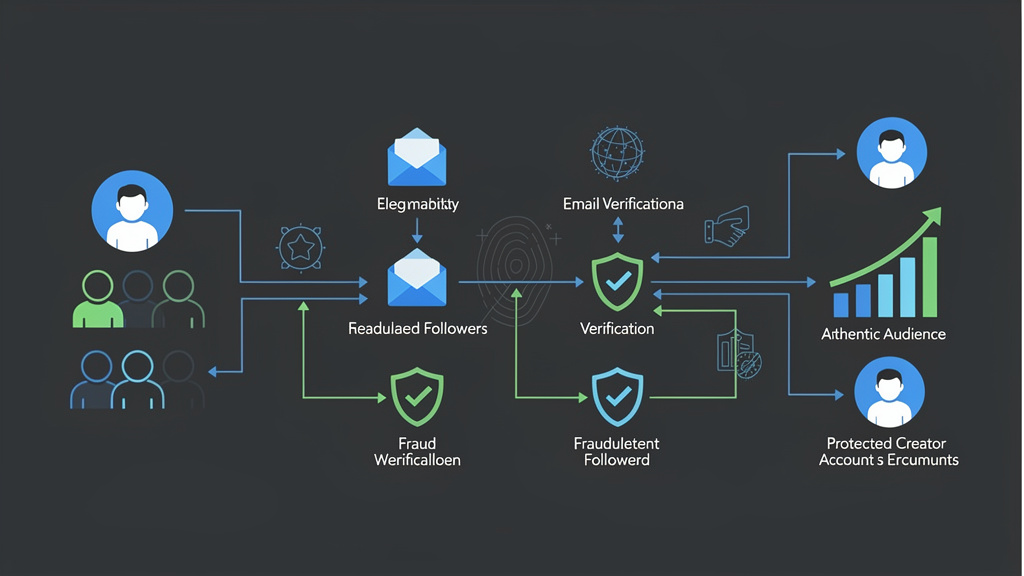
The Creator Economy Fraud Problem Is Bigger Than You Think
The creator economy has exploded into a $250 billion industry, according to Goldman Sachs research published in 2023, with projections pushing past $480 billion by 2027. But alongside this growth, fraud has scaled proportionally — and in some categories, it has scaled faster than the legitimate market itself.
According to a 2023 report by HypeAuditor, approximately 49.23% of Instagram accounts show signs of fraudulent activity, including fake followers, bot engagement, and purchased audience metrics. For brands spending money on influencer marketing — a market valued at $21.1 billion in 2023 according to Influencer Marketing Hub — this represents a catastrophic misallocation of advertising budget. But the fraud doesn't stop at inflated follower counts. It runs deeper, into the infrastructure of creator platforms themselves.
When a fraudster creates a fake account on your platform, they typically start with an email address. That email address is either:
- Completely fabricated (a random string at a non-existent domain)
- A temporary or disposable address from services like Mailinator, Guerrilla Mail, or 10 Minute Mail
- A real address that has been stolen through credential stuffing or data breaches
- A role-based or catch-all address being used to bypass single-account restrictions
Each of these fraud vectors has a different technical signature, and each requires a different detection strategy. The failure to understand these distinctions is why so many creator platforms implement email verification theater — a confirmation email that looks like security but stops almost none of the real fraud.
Why Creator Platforms Are Uniquely Vulnerable
Creator platforms face a fraud threat profile that is fundamentally different from standard e-commerce or SaaS applications. The incentive structures are different. On a creator platform, fake accounts have direct monetary value: they inflate follower counts, which increases a creator's perceived influence, which translates to higher brand deal valuations. A creator with 100,000 followers commands dramatically different rates than one with 10,000, even when the audience quality is identical.
This creates a perverse incentive loop. Creators have financial motivation to acquire fake followers. Fake follower services have financial motivation to create convincing fake accounts. And platform operators are caught in the middle, trying to maintain audience integrity metrics that directly affect their platform's credibility with advertisers and brands.
Beyond follower fraud, creator platforms face:
- Subscription fraud: Using stolen payment methods combined with disposable email addresses to access premium content
- Referral abuse: Creating multiple fake accounts to game referral bonus systems
- Content theft: Using fake accounts to access and redistribute premium content
- Identity impersonation: Creating fake creator accounts to deceive fans into sending payments to fraudulent channels
- Chargeback fraud: Subscribing with stolen cards, consuming content, then disputing the charge
According to Sift's 2023 Digital Trust and Safety Index, content platforms experience a fraud rate of 3.6% across all transactions — significantly higher than the 2.1% average across all industries. For a platform processing $10 million in creator subscriptions annually, that represents $360,000 in fraudulent transactions.
Understanding the Technical Anatomy of Fake Email Addresses
Before you can stop fake email fraud, you need to understand what makes an email address fake at a technical level. This goes far deeper than checking whether an address contains an @ symbol.
RFC 5321 and the SMTP Validation Layer
RFC 5321, which defines the Simple Mail Transfer Protocol, establishes the technical specifications that all legitimate email addresses must conform to. A syntactically valid email address according to RFC 5321 consists of a local part, an @ symbol, and a domain. But syntactic validity is the absolute minimum bar — it tells you almost nothing about whether the address is real, deliverable, or associated with a legitimate human being.
The SMTP validation process involves several layers of technical verification that happen in sequence:
Layer 1: Syntax Validation The address must conform to RFC 5321 format rules. The local part can contain alphanumeric characters and specific special characters. The domain must be a valid FQDN (Fully Qualified Domain Name). Maximum length for the entire address is 254 characters per RFC 5321 Section 4.5.3.1.
Layer 2: DNS MX Record Lookup Every legitimate email domain must have at least one MX (Mail Exchange) record in DNS. This record tells SMTP servers where to deliver email for that domain. A domain without MX records cannot receive email — full stop. Checking for MX records is one of the fastest and most reliable signals of address legitimacy.
import dns.resolver
import dns.exception

def check_mx_records(domain: str) -> dict:
    """
    Perform MX record lookup for email domain validation.
    Returns dict with mx_found bool and list of mx_records.
    """
    result = {
        "domain": domain,
        "mx_found": False,
        "mx_records": [],
        "error": None
    }

    try:
        mx_records = dns.resolver.resolve(domain, 'MX')
        result["mx_found"] = True
        result["mx_records"] = [
            {
                "priority": record.preference,
                "exchange": str(record.exchange)
            }
            for record in sorted(mx_records, key=lambda x: x.preference)
        ]
    except dns.resolver.NXDOMAIN:
        result["error"] = "Domain does not exist"
    except dns.resolver.NoAnswer:
        result["error"] = "No MX records found"
    except dns.exception.Timeout:
        result["error"] = "DNS lookup timed out"
    except Exception as e:
        result["error"] = f"Unexpected DNS error: {str(e)}"

    return result
Layer 3: SMTP Mailbox Verification The deepest technical layer involves actually connecting to the mail server via SMTP and verifying that the specific mailbox exists. This process uses the RCPT TO command defined in RFC 5321 Section 3.3. The server's response code tells you whether the mailbox is valid:
- 250: Mailbox exists and is accepting mail
- 450: Mailbox temporarily unavailable (often a greylisting response)
- 550: Mailbox does not exist
- 551: User not local; please try forwarding
- 552: Mailbox storage exceeded
RFC 3463 defines enhanced status codes that provide additional granularity. For example, a 550 5.1.1 response specifically indicates "The address that you tried to reach does not exist." A 550 5.7.1 indicates the message was rejected due to policy — a different problem entirely.
Disposable Email Domain Detection
Disposable email services are a major vector for fake account creation on creator platforms. Services like Mailinator, Guerrilla Mail, YOPmail, and hundreds of others provide temporary inboxes that can receive a confirmation email but are abandoned immediately afterward.
The technical signature of disposable email services varies:
- Known disposable domains: Maintained in regularly updated blocklists. There are over 159,000+ known disposable email domains, with new ones being created constantly.
- Catch-all domains: Domains configured to accept email for any local part (any address @thatdomain.com is valid). These are often used for bulk fake account creation.
- Subdomain generators: Services that generate unique subdomains to evade domain-level blocklists.
Detecting catch-all configurations requires a specific SMTP test: send a RCPT TO command with a randomly generated address that almost certainly doesn't exist. If the server returns 250 (accepted), the domain is configured as catch-all, and individual mailbox verification is unreliable.
Real-Time Email Verification at Signup: Implementation Patterns
The most effective point to stop fake email fraud is at the moment of account creation. Every millisecond of delay between a bad email address entering your system and being detected is an opportunity for fraud to establish a foothold. Real-time verification at signup is not optional for creator platforms — it is a fundamental security requirement.
The MailValid API Integration Pattern
For production creator platforms, building and maintaining your own email verification infrastructure is prohibitively expensive. You need to maintain disposable domain lists, manage SMTP connection pools across hundreds of mail servers, handle rate limiting from major providers like Gmail and Outlook, and keep up with constantly evolving fraud patterns. This is exactly the problem that MailValid.io solves.
Here is a production-ready integration pattern for creator platform signup flows:
import requests
import logging
from typing import Optional
from dataclasses import dataclass
from enum import Enum

logger = logging.getLogger(__name__)

class EmailRiskLevel(Enum):
    SAFE = "safe"
    SUSPICIOUS = "suspicious"
    HIGH_RISK = "high_risk"
    INVALID = "invalid"

@dataclass
class EmailVerificationResult:
    email: str
    is_valid: bool
    is_deliverable: bool
    is_disposable: bool
    is_role_based: bool
    risk_level: EmailRiskLevel
    mx_found: bool
    smtp_check: bool
    score: float
    reason: Optional[str] = None

class MailValidClient:
    """
    Production MailValid.io client with retry logic,
    timeout handling, and structured result parsing.
    """

    BASE_URL = "https://mailvalid.io/api/v1"
    DEFAULT_TIMEOUT = 5  # seconds — keep signup flow responsive
    MAX_RETRIES = 2

    def __init__(self, api_key: str):
        self.api_key = api_key
        self.session = requests.Session()
        self.session.headers.update({
            "X-API-Key": self.api_key,
            "Content-Type": "application/json",
            "User-Agent": "CreatorPlatform/1.0"
        })

    def verify_email(
        self,
        email: str,
        timeout: int = DEFAULT_TIMEOUT
    ) -> EmailVerificationResult:
        """
        Verify an email address using MailValid API.
        Includes retry logic for transient failures.
        Falls back to basic validation on API unavailability.
        """

        last_exception = None

        for attempt in range(self.MAX_RETRIES + 1):
            try:
                response = requests.post(
                    f"{self.BASE_URL}/verify",
                    headers={"X-API-Key": "mv_live_key"},
                    json={"email": "[email protected]"}
                )
                result = response.json()

                # Map API response to structured result
                return self._parse_response(email, result)

            except requests.exceptions.Timeout:
                last_exception = Exception(f"API timeout after {timeout}s")
                logger.warning(
                    f"MailValid timeout on attempt {attempt + 1} "
                    f"for email domain {email.split('@')[1]}"
                )
            except requests.exceptions.ConnectionError as e:
                last_exception = e
                logger.error(f"MailValid connection error: {e}")
            except requests.exceptions.HTTPError as e:
                if response.status_code == 429:
                    # Rate limited — don't retry aggressively
                    logger.warning("MailValid rate limit hit")
                    break
                elif response.status_code >= 500:
                    last_exception = e
                    logger.error(f"MailValid server error: {response.status_code}")
                else:
                    raise  # 4xx errors are our fault, don't retry

        # Fallback: allow signup but flag for async re-verification
        logger.error(
            f"MailValid unavailable after {self.MAX_RETRIES} retries: "
            f"{last_exception}"
        )
        return self._fallback_result(email)

    def _parse_response(
        self,
        email: str,
        api_response: dict
    ) -> EmailVerificationResult:
        """Parse MailValid API response into structured result."""

        score = api_response.get("score", 0.0)

        if score >= 0.8:
            risk_level = EmailRiskLevel.SAFE
        elif score >= 0.5:
            risk_level = EmailRiskLevel.SUSPICIOUS
        elif score >= 0.2:
            risk_level = EmailRiskLevel.HIGH_RISK
        else:
            risk_level = EmailRiskLevel.INVALID

        return EmailVerificationResult(
            email=email,
            is_valid=api_response.get("is_valid", False),
            is_deliverable=api_response.get("is_deliverable", False),
            is_disposable=api_response.get("is_disposable", False),
            is_role_based=api_response.get("is_role_based", False),
            risk_level=risk_level,
            mx_found=api_response.get("mx_found", False),
            smtp_check=api_response.get("smtp_check", False),
            score=score,
            reason=api_response.get("reason")
        )

    def _fallback_result(self, email: str) -> EmailVerificationResult:
        """
        Permissive fallback when API is unavailable.
        Flag for async re-verification rather than blocking signup.
        """
        return EmailVerificationResult(
            email=email,
            is_valid=True,  # Don't block on API failure
            is_deliverable=False,  # Unknown
            is_disposable=False,  # Unknown
            is_role_based=False,  # Unknown
            risk_level=EmailRiskLevel.SUSPICIOUS,
            mx_found=False,
            smtp_check=False,
            score=0.5,
            reason="verification_deferred"
        )


def handle_creator_signup(
    email: str,
    platform_tier: str,
    client: MailValidClient
) -> dict:
    """
    Main signup handler integrating email verification
    with risk-based decision logic for creator platforms.
    """

    verification = client.verify_email(email)

    # Hard block: syntactically invalid or no MX records
    if not verification.is_valid or not verification.mx_found:
        return {
            "allowed": False,
            "reason": "invalid_email",
            "user_message": (
                "This email address doesn't appear to be valid. "
                "Please check for typos and try again."
            )
        }

    # Hard block: confirmed disposable email on paid tiers
    if verification.is_disposable and platform_tier in ["premium", "creator_pro"]:
        return {
            "allowed": False,
            "reason": "disposable_email_blocked",
            "user_message": (
                "Temporary email addresses cannot be used for paid subscriptions. "
                "Please use your primary email address."
            )
        }

    # Soft challenge: high risk score — require additional verification
    if verification.risk_level == EmailRiskLevel.HIGH_RISK:
        return {
            "allowed": True,
            "requires_phone_verification": True,
            "reason": "elevated_risk",
            "user_message": (
                "Please verify your phone number to complete signup."
            )
        }

    # Suspicious: allow but queue for monitoring
    if verification.risk_level == EmailRiskLevel.SUSPICIOUS:
        return {
            "allowed": True,
            "requires_phone_verification": False,
            "flag_for_review": True,
            "reason": "suspicious_email",
            "user_message": None  # Silent flag
        }

    # Clean: standard signup flow
    return {
        "allowed": True,
        "requires_phone_verification": False,
        "flag_for_review": False,
        "reason": "verified_clean",
        "user_message": None
    }
Asynchronous Verification for High-Volume Platforms
For platforms processing thousands of signups per hour, synchronous email verification can introduce latency that degrades user experience. The solution is a hybrid approach: perform fast, lightweight checks synchronously (syntax, MX records, known disposable domain list) and defer the heavier SMTP verification to an asynchronous queue.
// Node.js async verification queue pattern
// Using Bull queue with Redis backend

const Queue = require('bull');
const axios = require('axios');

const emailVerificationQueue = new Queue('email-verification', {
  redis: {
    host: process.env.REDIS_HOST,
    port: process.env.REDIS_PORT,
    password: process.env.REDIS_PASSWORD
  },
  defaultJobOptions: {
    attempts: 3,
    backoff: {
      type: 'exponential',
      delay: 2000
    },
    removeOnComplete: 100,
    removeOnFail: 500
  }
});

// Queue processor
emailVerificationQueue.process(async (job) => {
  const { userId, email, signupContext } = job.data;

  try {
    const response = await axios.post(
      'https://mailvalid.io/api/v1/verify',
      { email },
      {
        headers: {
          'X-API-Key': process.env.MAILVALID_API_KEY,
          'Content-Type': 'application/json'
        },
        timeout: 10000 // 10s timeout for async context
      }
    );

    const result = response.data;

    // Update user risk profile in database
    await updateUserRiskProfile(userId, {
      emailVerified: result.is_valid && result.is_deliverable,
      emailRiskScore: result.score,
      isDisposable: result.is_disposable,
      verifiedAt: new Date().toISOString(),
      verificationSource: 'mailvalid_async'
    });

    // Trigger downstream actions based on result
    if (result.is_disposable || result.score < 0.3) {
      await flagAccountForReview(userId, {
        reason: 'failed_async_email_verification',
        details: result
      });

      // Optionally suspend account pending manual review
      if (signupContext.tier === 'paid' && result.score < 0.2) {
        await suspendAccount(userId, 'email_fraud_risk');
        await notifyTrustAndSafetyTeam(userId, result);
      }
    }

    return { success: true, userId, score: result.score };

  } catch (error) {
    if (error.response?.status === 429) {
      // Rate limited — schedule retry with longer delay
      throw new Error('RATE_LIMITED');
    }

    console.error(`Email verification failed for user ${userId}:`, error.message);
    throw error; // Bull will handle retry logic
  }
});

// Enqueue verification at signup
async function enqueueEmailVerification(userId, email, signupContext) {
  const job = await emailVerificationQueue.add(
    { userId, email, signupContext },
    {
      delay: 1000, // 1 second delay to let signup complete
      priority: signupContext.tier === 'paid' ? 1 : 10 // Paid users get priority
    }
  );

  return job.id;
}

module.exports = { enqueueEmailVerification, emailVerificationQueue };
Fraud Patterns Specific to Creator Platforms: A Technical Taxonomy
Understanding the specific fraud patterns that target creator platforms allows you to design verification systems that address the actual threat landscape rather than generic fraud patterns.
Bot Farm Account Creation
Bot farms create accounts at scale using automated scripts. These scripts typically cycle through lists of pre-generated email addresses, often using patterns like [email protected]. Modern bot farms use residential proxy networks to evade IP-based blocking, making email verification one of the few reliable signals remaining.
The technical signature of bot farm signups includes:
- High velocity of signups from similar email patterns
- Email addresses that pass syntax checks but fail SMTP verification
- Accounts created with minimal profile completion
- Identical or near-identical behavioral patterns (same time-to-complete-signup, same navigation paths)
According to Arkose Labs' 2023 Fraud and Abuse Report, 73% of all account registration attacks involve bots, and the sophistication of these bots has increased dramatically — with 45% now capable of solving standard CAPTCHA challenges. Email verification provides a layer of defense that CAPTCHA alone cannot.
Credential Stuffing and Account Takeover
Credential stuffing attacks use lists of username/password combinations leaked from data breaches to take over existing accounts. According to the Verizon 2023 Data Breach Investigations Report, credential stuffing accounts for 86% of web application attacks. For creator platforms, account takeover is particularly damaging because:
- Attackers can redirect creator payout accounts to fraudulent bank accounts
- Stolen creator identities can be used to solicit payments from fans
- Subscriber lists can be harvested and sold or used for phishing
Email verification at the point of account changes — not just signup — is critical here. When a user attempts to change their email address, the new address should undergo full verification before the change is committed. A 550 SMTP response on the new address is a strong signal of an account takeover attempt.
Subscription Fraud and Chargeback Abuse
Subscription fraud on creator platforms follows a predictable pattern: a fraudster uses a stolen credit card combined with a disposable email address to subscribe to premium content. They consume the content, then either the stolen card is reported and the charge is reversed, or they proactively dispute the charge claiming they never received the service.
The email address is the linking mechanism between the payment and the account. Disposable email addresses have a dramatically higher correlation with fraudulent payment methods. According to Chargebacks911's 2023 Chargeback Field Report, accounts with disposable email addresses have a chargeback rate 6.8 times higher than accounts with verified permanent email addresses.
Fake Follower Services and Engagement Pods
Engagement pods and fake follower services operate by creating networks of fake accounts that follow creators, like content, and leave comments to artificially inflate engagement metrics. These services have become sophisticated enough to mimic human behavior patterns, but they still rely on email addresses to create accounts.
The email addresses used by these services typically come from one of three sources:
- Bulk-registered free email accounts: Gmail, Yahoo, and Outlook accounts created in bulk before those providers tightened their verification requirements
- Compromised real accounts: Legitimate accounts that have been taken over and are being used as part of a bot network
- Disposable email services: Temporary addresses used for initial verification, with the account then operating without active email monitoring
Balancing Frictionless Onboarding with Creator Platform Security
One of the most common mistakes product managers make when implementing email verification is treating it as a binary: either you verify or you don't. The reality is that email verification should be a graduated, risk-based system that applies appropriate friction based on the risk profile of the specific signup event.
The Friction Spectrum
Think of your verification system as a spectrum with four positions:
Position 1: Silent Verification (Zero Friction) For low-risk signups — a free tier account from a verified email domain with normal behavioral signals — you run full email verification in the background and allow the signup to proceed without any user-facing friction. The user never knows verification happened.
Position 2: Soft Challenge (Minimal Friction) For medium-risk signups — suspicious email patterns, new domains, role-based addresses — you allow the signup but require the user to click a confirmation link before accessing key features. This is standard email confirmation flow, but triggered selectively rather than universally.
Position 3: Hard Challenge (Significant Friction) For high-risk signups — known disposable domains, failed SMTP verification, high-risk IP correlation — you require additional verification such as phone number confirmation or identity document upload before the account can be activated.
Position 4: Hard Block (Maximum Friction) For confirmed fraud indicators — invalid email, no MX records, confirmed disposable email on paid tiers — you block the signup entirely with a clear user-facing message.
Creator-Specific Onboarding Considerations
Creator platforms have unique onboarding dynamics that affect how you should implement verification friction. Creators — the supply side of your marketplace — are often less technically sophisticated than the developers building for them, and they have high expectations for a smooth signup experience because they are evaluating your platform as a business tool.
A creator who encounters aggressive verification friction during signup will simply go to a competitor. According to Baymard Institute research, 18% of users abandon checkout specifically because of overly complex account creation processes. For creator platforms where the creator is the product, losing a high-quality creator to friction is far more costly than the fraud you were trying to prevent.
The solution is to apply the heaviest verification friction to the subscriber/fan side of the platform, where fraud risk is highest and the cost of friction is lowest. A fan who encounters a phone verification step before subscribing to their favorite creator is inconvenienced but will likely complete the process. A creator encountering the same friction during their initial platform setup is far more likely to abandon.
Progressive Trust Building
Rather than front-loading all verification at signup, consider a progressive trust model:
- Signup: Verify email syntax and MX records, check against disposable domain list
- First content access: Trigger SMTP-level mailbox verification
- First payment: Require full email verification plus payment method verification
- Payout request: Require identity verification and verified email confirmation
This approach distributes friction across the user journey in proportion to the risk of each action, minimizing abandonment while maximizing fraud prevention at the highest-risk touchpoints.
Integration Patterns with Major Creator Platforms
Creator platform infrastructure is rarely built entirely in-house. Most platforms integrate with existing tools and infrastructure — payment processors, content delivery networks, analytics platforms, and increasingly, established creator platform APIs. Email verification needs to integrate cleanly with these existing systems.
Patreon-Style Membership Platform Integration
Platforms modeled on the Patreon membership model have a specific verification challenge: the same user may exist both as a creator (who needs high trust) and as a patron/subscriber (who may be lower trust). Your verification system needs to handle these dual roles.
from enum import Enum
from dataclasses import dataclass
from typing import Optional
import logging

logger = logging.getLogger(__name__)

class UserRole(Enum):
    CREATOR = "creator"
    SUBSCRIBER = "subscriber"
    BOTH = "both"

class VerificationTier(Enum):
    BASIC = "basic"          # Syntax + MX only
    STANDARD = "standard"    # + SMTP check
    ENHANCED = "enhanced"    # + Identity verification
    FULL = "full"            # + Payment method verification

@dataclass
class PlatformUser:
    email: str
    role: UserRole
    subscription_tier: Optional[str]
    monthly_revenue: float  # For creators: monthly earnings
    is_featured: bool

def determine_verification_tier(user: PlatformUser) -> VerificationTier:
    """
    Determine appropriate verification tier based on user role
    and platform context for Patreon-style platforms.
    """

    # Creators with significant revenue require full verification
    if user.role in [UserRole.CREATOR, UserRole.BOTH]:
        if user.monthly_revenue > 1000 or user.is_featured:
            return VerificationTier.FULL
        return VerificationTier.ENHANCED

    # Paid subscribers require standard verification
    if user.subscription_tier in ["premium", "vip", "founding_member"]:
        return VerificationTier.STANDARD

    # Free subscribers get basic verification
    return VerificationTier.BASIC


async def verify_platform_user(
    user: PlatformUser,
    mailvalid_client,
    db_session
) -> dict:
    """
    Complete verification flow for membership platform user.
    Handles both creator and subscriber verification paths.
    """

    verification_tier = determine_verification_tier(user)

    # All tiers start with MailValid API check
    email_result = mailvalid_client.verify_email(user.email)

    # Store verification result
    await db_session.execute(
        """
        INSERT INTO email_verifications
        (email, score, is_valid, is_disposable, mx_found,
         smtp_check, verified_at, verification_tier)
        VALUES ($1, $2, $3, $4, $5, $6, NOW(), $7)
        ON CONFLICT (email) DO UPDATE SET
            score = EXCLUDED.score,
            verified_at = EXCLUDED.verified_at
        """,
        user.email, email_result.score, email_result.is_valid,
        email_result.is_disposable, email_result.mx_found,
        email_result.smtp_check, verification_tier.value
    )

    # Creator-specific additional checks
    if user.role in [UserRole.CREATOR, UserRole.BOTH]:
        # Verify creator's email domain reputation
        domain = user.email.split('@')[1]
        domain_reputation = await check_domain_reputation(domain)

        if domain_reputation['spam_score'] > 0.7:
            logger.warning(
                f"Creator signup from high-spam-score domain: {domain}"
            )
            return {
                "verified": False,
                "reason": "domain_reputation_risk",
                "requires_manual_review": True
            }

    # Final decision
    if not email_result.is_valid or not email_result.mx_found:
        return {"verified": False, "reason": "invalid_email"}

    if email_result.is_disposable and verification_tier != VerificationTier.BASIC:
        return {"verified": False, "reason": "disposable_email_not_allowed"}

    if email_result.score < 0.3:
        return {
            "verified": False,
            "reason": "low_trust_score",
            "requires_additional_verification": True
        }

    return {
        "verified": True,
        "trust_score": email_result.score,
        "verification_tier": verification_tier.value
    }
Substack-Style Newsletter Platform Integration
Newsletter platforms built on the Substack model have a specific verification challenge: subscriber email quality directly affects the sender reputation of every creator on the platform. When fake or invalid email addresses accumulate in creator subscriber lists, the resulting bounce rates damage the deliverability of all creators sharing the same sending infrastructure.
This is where RFC 7208 (SPF), RFC 6376 (DKIM), and RFC 7489 (DMARC) become directly relevant to creator platform security. A platform's sender reputation is built on these authentication standards, and that reputation is degraded by every bounced email sent to an invalid address.
A typical platform DNS configuration for a newsletter platform would look like:
; SPF record — authorizes sending infrastructure
newsletter-platform.com.  IN  TXT  "v=spf1 include:sendgrid.net include:mailgun.org ip4:203.0.113.0/24 ~all"

; DKIM record — cryptographic signature for email authentication
; (selector._domainkey.newsletter-platform.com)
s1._domainkey.newsletter-platform.com.  IN  TXT  "v=DKIM1; k=rsa; p=MIGfMA0GCSqGSIb3DQEBAQUAA4GNADCBiQKBgQC..."

; DMARC record — policy for authentication failures
_dmarc.newsletter-platform.com.  IN  TXT  "v=DMARC1; p=quarantine; rua=mailto:[email protected]; ruf=mailto:[email protected]; pct=100; adkim=s; aspf=s"
When a creator's subscriber list contains invalid addresses and bounces accumulate, SMTP servers respond with enhanced status codes per RFC 3463. A 550 5.1.1 response (address does not exist) is a hard bounce that should immediately trigger removal of that address from all creator lists on the platform. A 421 4.2.1 response indicates temporary unavailability and should trigger a retry after an appropriate backoff period.
According to Validity's 2023 State of Email report, list hygiene problems account for 17% of deliverability issues across email senders. For creator newsletter platforms, where deliverability is the core product value proposition, this number is likely higher due to the organic, less-curated nature of creator subscriber acquisition.
YouTube Membership Tier Integration
Platforms that mirror YouTube's membership tier model — offering tiered access to exclusive content at different price points — face a specific challenge: the same email address may be used across multiple tiers, and fraudsters often use account sharing or credential resale as their primary fraud vector.
Email verification in this context needs to detect not just fake addresses, but also addresses that are being used in suspicious patterns across your platform:
- The same email domain appearing across an unusual number of accounts
- Email addresses that match patterns associated with known credential resale marketplaces
- Accounts where the email address changes frequently (a signal of account takeover)
- Role-based email addresses (admin@, info@, support@) being used for individual subscriptions
Common Implementation Mistakes and How to Avoid Them
After analyzing fraud patterns across creator platforms, the same implementation mistakes appear repeatedly. Understanding these failure modes will save your platform significant fraud losses.
Mistake 1: Treating Email Confirmation as Email Verification
The most common mistake is conflating email confirmation (sending a link and waiting for a click) with email verification (technically verifying that the address is real and deliverable). Email confirmation proves that someone has access to an inbox. It does not prove that the inbox is legitimate, permanent, or not being used for fraud.
A fraudster using a disposable email address can easily click a confirmation link — that is exactly what disposable email services are designed for. Email confirmation must be combined with technical verification to be effective.
Mistake 2: Verifying Once and Never Again
Email addresses change status over time. A valid, deliverable email address today may become invalid tomorrow when a user cancels their email service. According to HubSpot research, email lists decay at approximately 22.5% per year naturally, meaning nearly a quarter of your verified email addresses become invalid within 12 months.
For creator platforms, this means periodic re-verification of subscriber lists is essential. A recommended schedule:
- Active paying subscribers: Re-verify every 90 days
- Free tier subscribers: Re-verify every 180 days
- Inactive accounts (no login in 6+ months): Re-verify before any re-engagement campaign
- Creator accounts with payout requests: Re-verify at each payout cycle
Mistake 3: Blocking All Role-Based Addresses
Role-based email addresses (admin@, info@, support@, hello@) are often flagged as high-risk because they are not associated with a specific individual. However, on creator platforms, many legitimate creators use role-based addresses for their professional communications. A creator running a media company might legitimately use [email protected].
The correct approach is to flag role-based addresses for additional verification rather than blocking them outright, and to apply different policies based on user role (creator vs. subscriber).
Mistake 4: Ignoring the Verification API Response Time Budget
Email verification API calls have latency. SMTP-level verification in particular can take 2-5 seconds when connecting to mail servers. If you block your signup form submission waiting for a synchronous verification response, you will see significant abandonment rates.
The solution is to set strict timeout budgets for synchronous verification (typically 3 seconds maximum) and fall back to asynchronous verification for any checks that exceed that budget. The code examples earlier in this post demonstrate this pattern.
Mistake 5: Not Monitoring Verification Metrics
Email verification is not a set-and-forget system. You need to monitor:
- Verification pass rate by acquisition channel: If one traffic source has a dramatically lower pass rate, it may be a fraud traffic source
- Disposable email rate trends: A spike in disposable email attempts often precedes a coordinated fraud attack
- API error rates: High error rates from your verification provider may indicate you're being targeted by a bot farm that is deliberately trying to exhaust your verification budget
- Correlation between verification score and downstream fraud events: This calibrates your risk thresholds over time
Measuring the ROI of Email Verification for Creator Platforms
Implementing email verification has real costs: API fees, engineering time, and some level of legitimate user friction. Measuring the return on that investment requires tracking specific metrics before and after implementation.
Key Metrics to Track
Fake Account Rate: The percentage of new accounts that are subsequently identified as fake. Industry benchmarks suggest creator platforms without verification see fake account rates of 15-25% of all new signups. With comprehensive email verification, this typically drops to 2-5%.
Chargeback Rate: The percentage of subscription transactions that result in chargebacks. Accounts with verified email addresses have dramatically lower chargeback rates. According to Chargebacks911, the industry average chargeback rate is 0.6%, but platforms with email verification consistently achieve rates below 0.3%.
Email Deliverability Rate: The percentage of emails sent to subscribers that are successfully delivered. Platforms with strong email verification maintain deliverability rates above 98%. Platforms without verification commonly see deliverability rates drop to 85-90% as invalid addresses accumulate.
Creator Revenue Accuracy: For platforms that use follower/subscriber counts to calculate creator payouts or brand deal valuations, fake account removal directly improves the accuracy of these metrics. Brands paying for influencer campaigns on your platform will see better ROI, increasing their lifetime value.
Calculating the Business Case
For a creator platform with 100,000 active subscribers and $500,000 in monthly subscription revenue:
- Fraud prevention value: At a 3.6% fraud rate without verification, that's $18,000/month in fraudulent transactions. With verification reducing fraud to 0.5%, savings are approximately $15,500/month.
- Deliverability value: Improving deliverability from 88% to 98% means 10,000 more emails reaching inboxes each month. For a platform where email is the primary creator-to-fan communication channel, this has direct impact on subscriber retention and renewal rates.
- Brand deal value: If your platform charges brands for influencer campaigns based on verified audience size, removing fake followers increases the credibility of your audience metrics and justifies premium pricing.
The math consistently shows that email verification ROI is strongly positive for creator platforms at almost any scale.
Best Practices Summary for Creator Platform Email Verification
Drawing together everything covered in this post, here are the essential best practices for implementing email verification on creator platforms:
- Implement layered verification: Combine syntax checking, MX record validation, SMTP verification, and disposable domain detection for comprehensive coverage
- Apply risk-based friction: Match verification intensity to the risk profile of each signup event rather than applying uniform friction to all users
- Differentiate by user role: Apply stricter verification to the subscriber/fan side of your platform where fraud risk is highest
- Use asynchronous verification for scale: Don't block signup flows with slow SMTP checks — use queued async verification with fast synchronous fallbacks
- Re-verify periodically: Email addresses decay at 22.5% per year; schedule regular re-verification of your subscriber base
- Monitor verification metrics continuously: Track pass rates, disposable email rates, and correlation with downstream fraud events
- Integrate with your payment stack: Trigger enhanced verification at payment events, not just at signup
- Maintain DNS authentication records: Keep your SPF, DKIM, and DMARC records current to protect your platform's sender reputation
- Handle API failures gracefully: Never block legitimate users because your verification API is temporarily unavailable — fail open with deferred verification
- Document your verification policy: Be transparent with creators about how you protect audience integrity; it is a competitive differentiator
Creator economy fraud is not going away. As the financial stakes of creator platforms grow, the sophistication and scale of fraud targeting those platforms will grow proportionally. The platforms that win long-term will be those that build trust infrastructure into their core architecture — not as an afterthought, but as a foundational layer that protects creators, subscribers, and the platform itself. Email verification is the most cost-effective, technically reliable starting point for that infrastructure. The question is not whether to implement it, but how quickly you can get it right.
[!TIP] Stop Fake Followers Before They Enter Your Platform MailValid.io provides enterprise-grade email verification built specifically for high-volume creator platforms. With real-time SMTP verification, disposable domain detection across 3,000+ known domains, catch-all domain identification, and a sub-200ms API response time, MailValid integrates into your signup and checkout flows without adding friction for legitimate users. Start protecting your creator platform today with 1,000 free verifications. No credit card required. Get Your Free API Key at MailValid.io
python # One API call. Complete email intelligence. import requests response = requests.post( "https://mailvalid.io/api/v1/verify", headers={"X-API-Key": "mv_live_key"}, json={"email": "[email protected]"} ) result = response.json() # result: {is_valid, is_deliverable, is_disposable, score, mx_found, smtp_check}
MailValid Team
Email verification experts
Join developers who verify smarter
Stop letting bad emails hurt your deliverability
100 free credits. $0.001/email after. Credits never expire. No credit card required.