
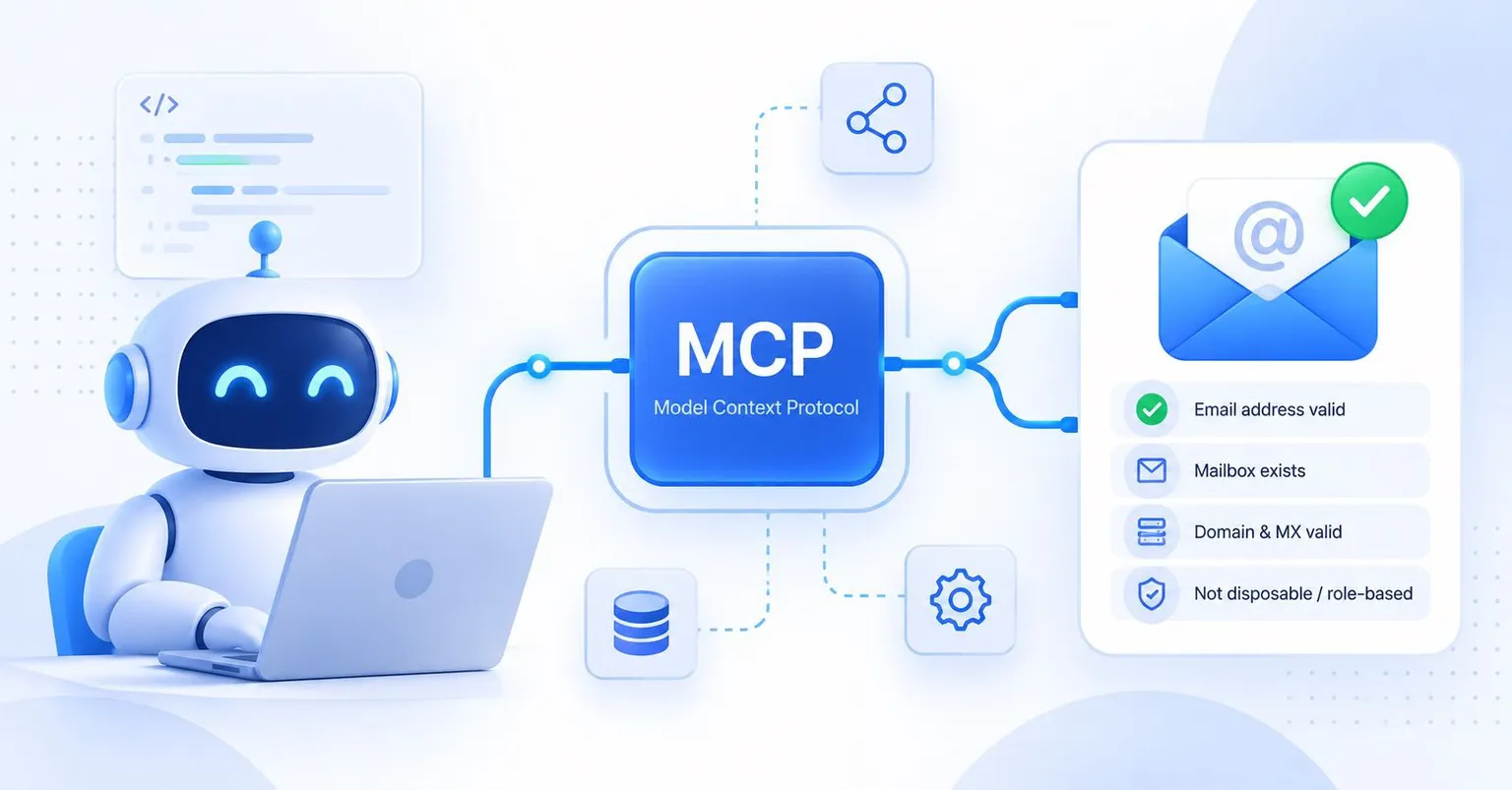
What is MCP?

MCP (Model Context Protocol) is an open standard, introduced by Anthropic in November 2024, that lets AI applications connect to external tools and data sources through a single, consistent interface. Instead of an AI agent needing a custom-built integration for every tool it uses, an MCP server exposes a defined set of callable "tools" that any MCP-compatible client, Claude, Cursor, VS Code, Windsurf, and others can call the same way.
For a developer, the practical effect is this: build one MCP server, and every MCP client that connects to it gets the same capabilities, without you writing a separate wrapper for each framework.
Why email verification needs an MCP server
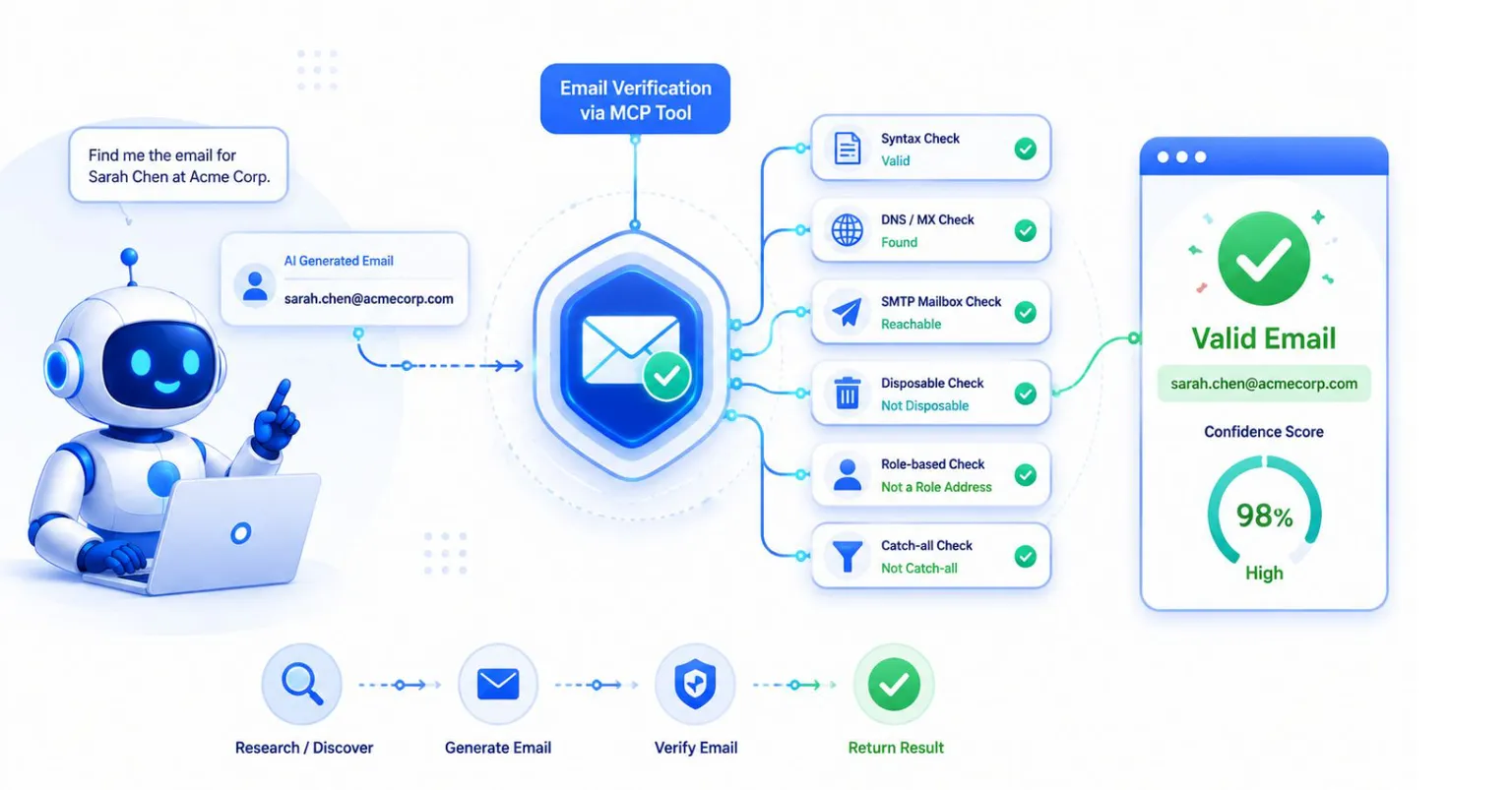 AI agents doing lead research, CRM cleanup, or outbound prep routinely generate email addresses that look correct -
 sarah.chen@acmecorp.com follows every naming convention a company might use but there's no way to know if the address is real without checking it. An agent that confidently hands back a plausible, unverified address is a specific kind of failure: it's not obviously wrong, so nobody catches it until the email bounces.
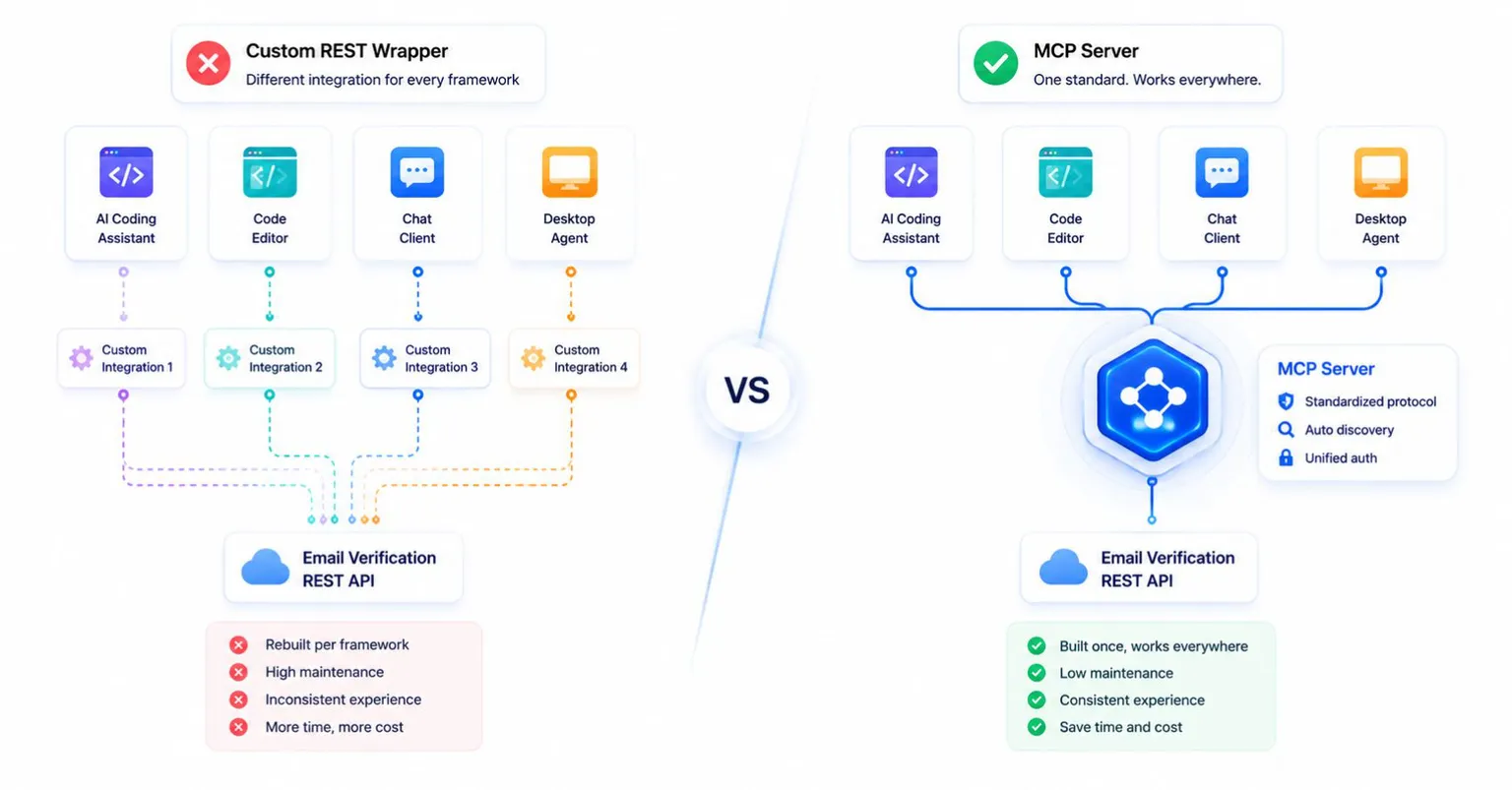
Wrapping a REST API for email verification in a custom tool solves this, but it means rebuilding the same integration in every agent framework you use, and maintaining all of them as the underlying API changes. An MCP server for email verification removes that duplication - the verification capability becomes available to any MCP client without per-framework glue code.
How MailValid's MCP server works
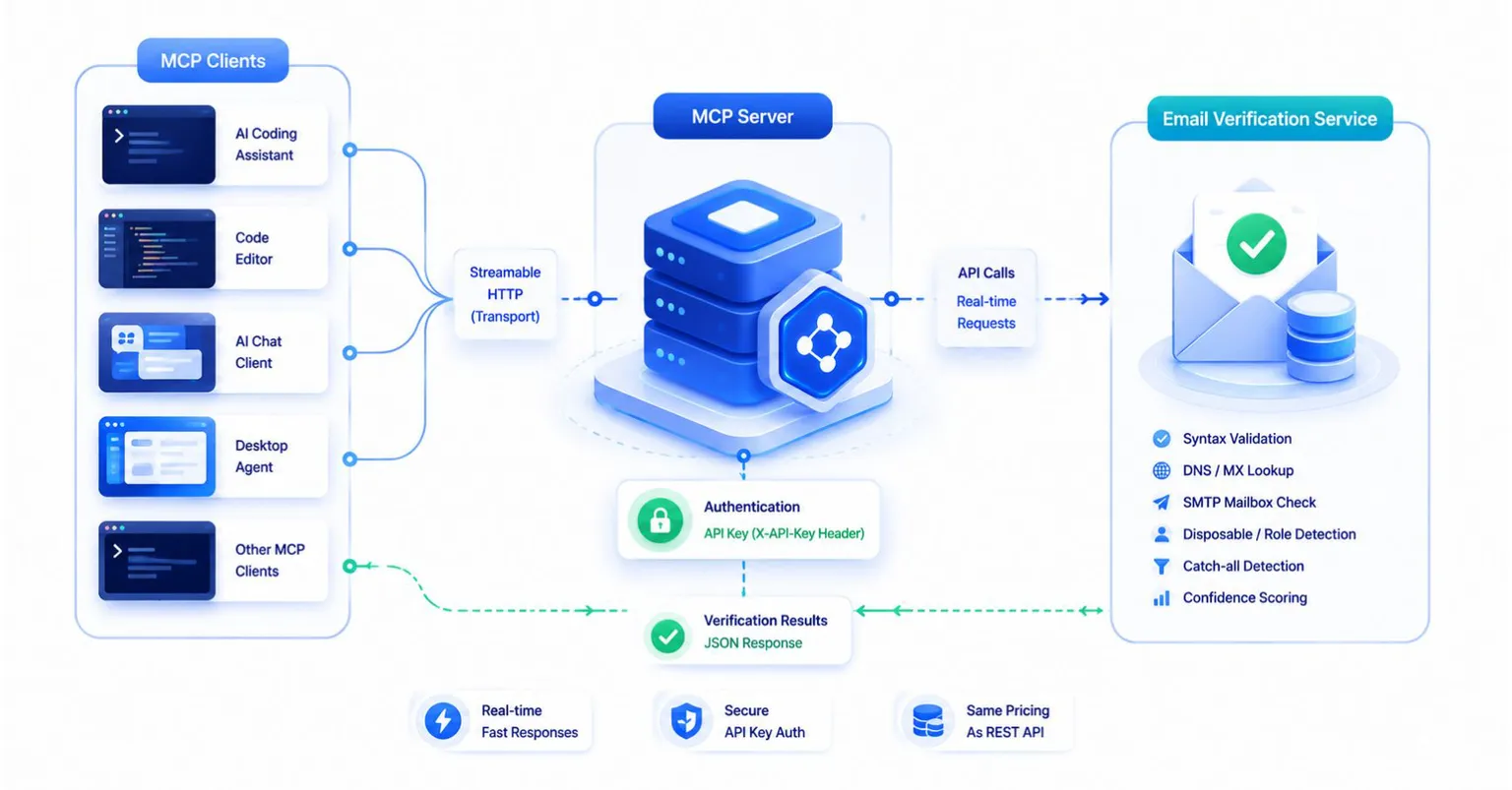 MailValid runs a hosted MCP server over the Streamable HTTP transport, authenticated the same way as the REST API (an API key), and billed identically - a
 verify_email call through MCP costs exactly what a POST /api/v1/verify/single call costs through the REST API.
Connecting directly (clients with native remote MCP support — Claude Code, Cursor, VS Code):
claude mcp add --transport http mailvalid https://mailvalid.io/mcp/ \
  --header "X-API-Key: mv_live_your_key_here"
Connecting via the launcher (stdio-only clients, like Claude Desktop):
{
  "mcpServers": {
    "mailvalid": {
      "command": "npx",
      "args": ["-y", "@mailvalid/mcp"],
      "env": { "MAILVALID_API_KEY": "mv_live_your_key_here" }
    }
  }
}
Once connected, the agent has access to eight tools:
| Tool | Auth required | Cost | What it does |
|---|---|---|---|
verify_email |
API key | 1 credit* | Full verification: syntax, DNS/MX, SMTP mailbox, disposable/role/catch-all detection, confidence score |
submit_bulk_verification |
API key | Reserves N credits | Queue a list for async verification |
get_bulk_job |
API key | Free | Check status/results of a bulk job |
list_bulk_jobs |
API key | Free | List recent bulk jobs |
cancel_bulk_job |
API key | Free | Cancel a job, release reserved credits |
get_credit_balance |
API key | Free | Current credit balance |
verify_email_demo |
None | Free | Syntax/disposable/role checks only, no SMTP, rate-limited per IP |
get_api_discovery |
None | Free | Machine-readable discovery URLs |
* Free for unknown results and recent cached repeats.
MCP vs. a custom REST wrapper: the actual difference
 | | Custom REST wrapper | MCP server |
| --- | --- | --- |
| Integration effort | Rebuilt per framework | Built once, works with any MCP client |
| Maintenance | You own it, every framework, indefinitely | Maintained by the API provider |
| Discovery | Manual documentation reading | Agents can discover available tools programmatically |
| Auth handling | Custom per integration | Standardized (API key/header, same pattern every client uses) |
| Time to first working call | Hours to a day, per framework | Minutes, per client |
| | Custom REST wrapper | MCP server |
| --- | --- | --- |
| Integration effort | Rebuilt per framework | Built once, works with any MCP client |
| Maintenance | You own it, every framework, indefinitely | Maintained by the API provider |
| Discovery | Manual documentation reading | Agents can discover available tools programmatically |
| Auth handling | Custom per integration | Standardized (API key/header, same pattern every client uses) |
| Time to first working call | Hours to a day, per framework | Minutes, per client |
Real use cases
Lead research agents return a confidence-scored list instead of a plausible-sounding one, because verification happens as part of the agent's own task execution, not a separate manual step afterward.
CRM cleanup agents check a record's email validity before flagging it as stale, rather than assuming staleness from inactivity alone.
Data enrichment pipelines treat verification as one call in a longer chain the agent orchestrates itself — find, verify, enrich, write back — without a human in the loop for the verification step specifically.
Signup abuse triage lets an agent inspect a suspicious cohort of signups and explain, with evidence (disposable domain flags, catch-all detection, confidence scores), what it found — rather than a human manually cross-referencing a spreadsheet.
How to set it up (step by step)
- Create a MailValid account at mailvalid.io/register — 100 free credits included, no card required.
- Generate an API key from the dashboard.
- Add the MCP server to your client's config using either the direct-connection or launcher method above, depending on whether your client supports native remote HTTP.
- Confirm the connection — most clients have a command to list active MCP servers (in Claude Code,
/mcp). - Test with the no-auth tools first. Call
verify_email_demobefore wiring in your real key, to confirm the connection works independent of billing/auth. - Start calling
verify_emailfrom your agent's own logic — most agents will do this automatically once the tool is available and the task calls for it; you generally don't need to hard-code when to call it.
Frequently asked questions
What is MCP used for? MCP standardizes how AI applications connect to external tools and data sources, so a tool built once (like an email verification server) works across every MCP-compatible client without custom integration work per framework.
Does MailValid's MCP server cost more than the REST API?
No — billing is identical. A verify_email call through MCP costs the same 1 credit as the equivalent REST API call, and draws from the same credit balance.
Can I try the MCP server without an API key?
Yes. verify_email_demo and get_api_discovery work with no authentication at all, so an agent (or you, testing manually) can confirm the connection before adding a real key.
Which MCP clients does MailValid support? Any MCP-compatible client — Claude Code, Cursor, VS Code (via GitHub Copilot), Claude Desktop, and Windsurf are explicitly documented, and any other client that supports the Streamable HTTP or stdio transport will work with the standard JSON configuration.
Is MCP the same as a plugin or a webhook? No. A webhook pushes data to you on an event; a plugin is typically single-platform. MCP is a two-way, standardized protocol specifically for AI agents to discover and call tools mid-task, across any compatible client.
Last updated: 10th August 2026.
MailValid Team
Email verification experts
Join teams that verify before they send
Stop letting bad emails hurt your deliverability
100 free credits. From $0.0008/email after. Credits never expire. No credit card required.