

Last updated: 23 June 2026
Most outbound fails for the same reason: it starts with strangers. You buy a list, write a clever line, blast 5,000 people who never asked to hear from you, and watch reply rates die in the low single digits. Warm outreach inverts the whole thing. Instead of guessing who might care, you only contact people who already told the internet they want what you sell - they posted about the problem, their company just raised, they're hiring for the exact gap you fill. The message lands warm because the timing is right and the personalization is real. This is the full system, end to end. Seven components: four that find buying signals, one that protects deliverability, one that personalizes at scale, and one that sequences it all into booked calls. The verification layer - where most "warm" systems quietly leak - is handled by MailValid, so the leads you worked so hard to find actually reach an inbox. Here's how every piece fits together.
The core idea: signal beats volume
A warm-email outreach system has one job - find intent, then act on it before it goes cold. Every component below exists to do one of three things: detect a buying signal, make sure the message is deliverable, or make the message feel one-to-one. Get those three right and you don't need volume. You need timing. The numbers back the shift. Cold email open rates (~27.7%) already beat broad B2B benchmarks because tighter targeting wins - but raw reply rates have slid from 8.5% in 2019 toward ~3.4% in 2026 as inboxes got noisier. The teams still pulling double-digit replies aren't sending more. They're sending to people who raised their hand, with copy built from that person's own words. Now the seven components.
1. The LinkedIn intent scraper
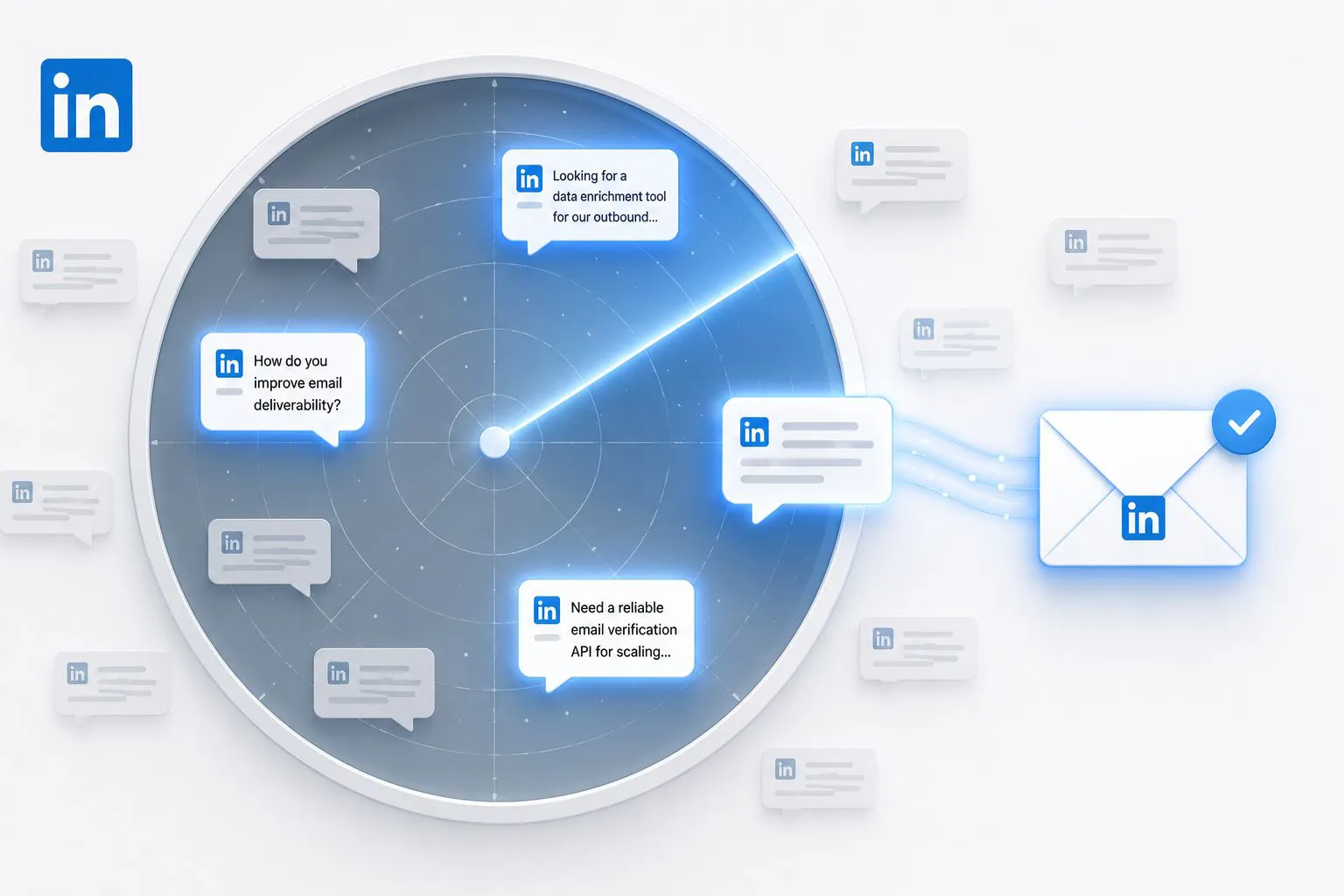 What it does: surfaces people posting active buying signals in the last 14 days, and turns their own post text into your personalization fuel.
Buying signals on LinkedIn are loud if you know the keyword clusters to listen for - phrases like "looking for a tool that," "anyone recommend," "we're struggling with," or "just started evaluating." A scraper built around those clusters pulls the person, the company, and the post itself. That post is gold: it's the prospect describing their problem in their own language, which becomes the first line of your email. No guessing about pain - they handed it to you.
Why it's first: intent is freshest here. A 14-day window means you're reaching someone while the problem is still top of mind, not three months after they've already solved it.
What it does: surfaces people posting active buying signals in the last 14 days, and turns their own post text into your personalization fuel.
Buying signals on LinkedIn are loud if you know the keyword clusters to listen for - phrases like "looking for a tool that," "anyone recommend," "we're struggling with," or "just started evaluating." A scraper built around those clusters pulls the person, the company, and the post itself. That post is gold: it's the prospect describing their problem in their own language, which becomes the first line of your email. No guessing about pain - they handed it to you.
Why it's first: intent is freshest here. A 14-day window means you're reaching someone while the problem is still top of mind, not three months after they've already solved it.
2. The job-board signal workflow
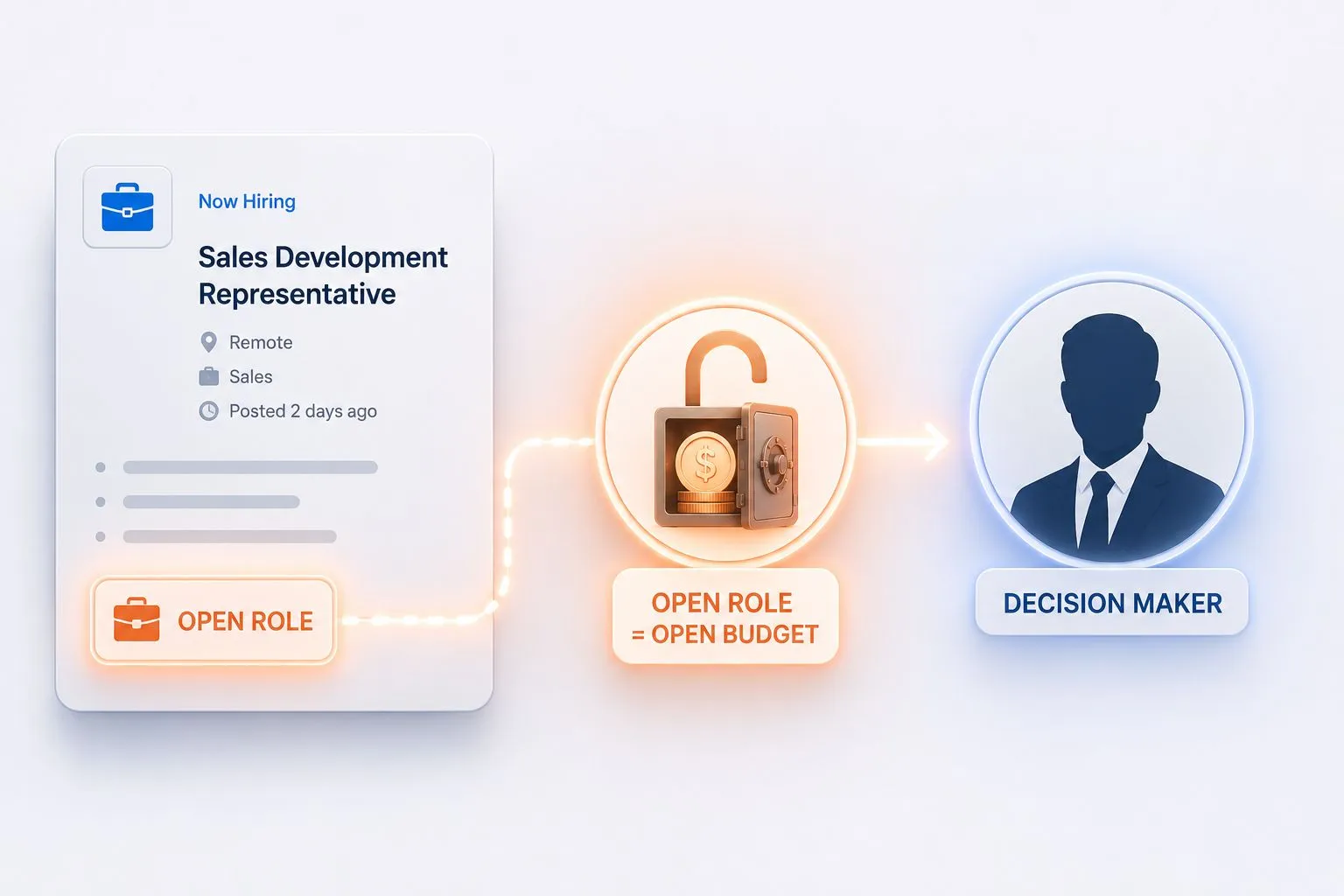 What it does: flags companies with open budget and an unsolved pipeline problem - before they waste six months hiring the wrong person.
A new job posting is a budget signal hiding in plain sight. When a company opens a role for "Head of Demand Gen" or "SDR Manager," they're publicly admitting a gap and allocating money to fix it. Title-based filters identify exactly these companies, letting you reach the decision-maker with a faster, cheaper path to the outcome they're about to spend a year hiring for.
The angle: you're not pitching a product. You're offering to solve the problem the job posting is trying to solve - right now, without the six-month ramp.
What it does: flags companies with open budget and an unsolved pipeline problem - before they waste six months hiring the wrong person.
A new job posting is a budget signal hiding in plain sight. When a company opens a role for "Head of Demand Gen" or "SDR Manager," they're publicly admitting a gap and allocating money to fix it. Title-based filters identify exactly these companies, letting you reach the decision-maker with a faster, cheaper path to the outcome they're about to spend a year hiring for.
The angle: you're not pitching a product. You're offering to solve the problem the job posting is trying to solve - right now, without the six-month ramp.
3. The Reddit + Quora pain scraper
 What it does: finds people venting about the exact issue you solve, unfiltered and in their own words.
LinkedIn is where people perform; Reddit and Quora are where they confess. A scraper pointed at the right subreddits and question threads - built on keyword clusters tied to your problem space - surfaces raw, emotional, specific complaints. These are the highest-context signals in the system because the language is honest. You learn the real objection, the real workaround, and the real frustration, all before you ever reach out.
Why it matters: the copy practically writes itself when you're echoing the exact phrase someone used to describe their pain at 1 a.m.
What it does: finds people venting about the exact issue you solve, unfiltered and in their own words.
LinkedIn is where people perform; Reddit and Quora are where they confess. A scraper pointed at the right subreddits and question threads - built on keyword clusters tied to your problem space - surfaces raw, emotional, specific complaints. These are the highest-context signals in the system because the language is honest. You learn the real objection, the real workaround, and the real frustration, all before you ever reach out.
Why it matters: the copy practically writes itself when you're echoing the exact phrase someone used to describe their pain at 1 a.m.
4. The funding radar
 What it does: flags Series A/B companies within 60 days of an announcement - when growth pressure is highest and the checkbook is open.
Fresh funding is the cleanest timing signal in B2B. A company that just raised has a board expecting growth, a mandate to spend, and 18 months of runway pressure starting the day the round closes. Filters that catch these companies inside a 60-day window put you in front of them at the exact moment "we'll think about it next quarter" turns into "we need this now."
The window matters: reach them in week two, not month six, and you're a solution to a fire instead of a line item to defer.
What it does: flags Series A/B companies within 60 days of an announcement - when growth pressure is highest and the checkbook is open.
Fresh funding is the cleanest timing signal in B2B. A company that just raised has a board expecting growth, a mandate to spend, and 18 months of runway pressure starting the day the round closes. Filters that catch these companies inside a 60-day window put you in front of them at the exact moment "we'll think about it next quarter" turns into "we need this now."
The window matters: reach them in week two, not month six, and you're a solution to a fire instead of a line item to defer.
5. The enrichment + verification layer
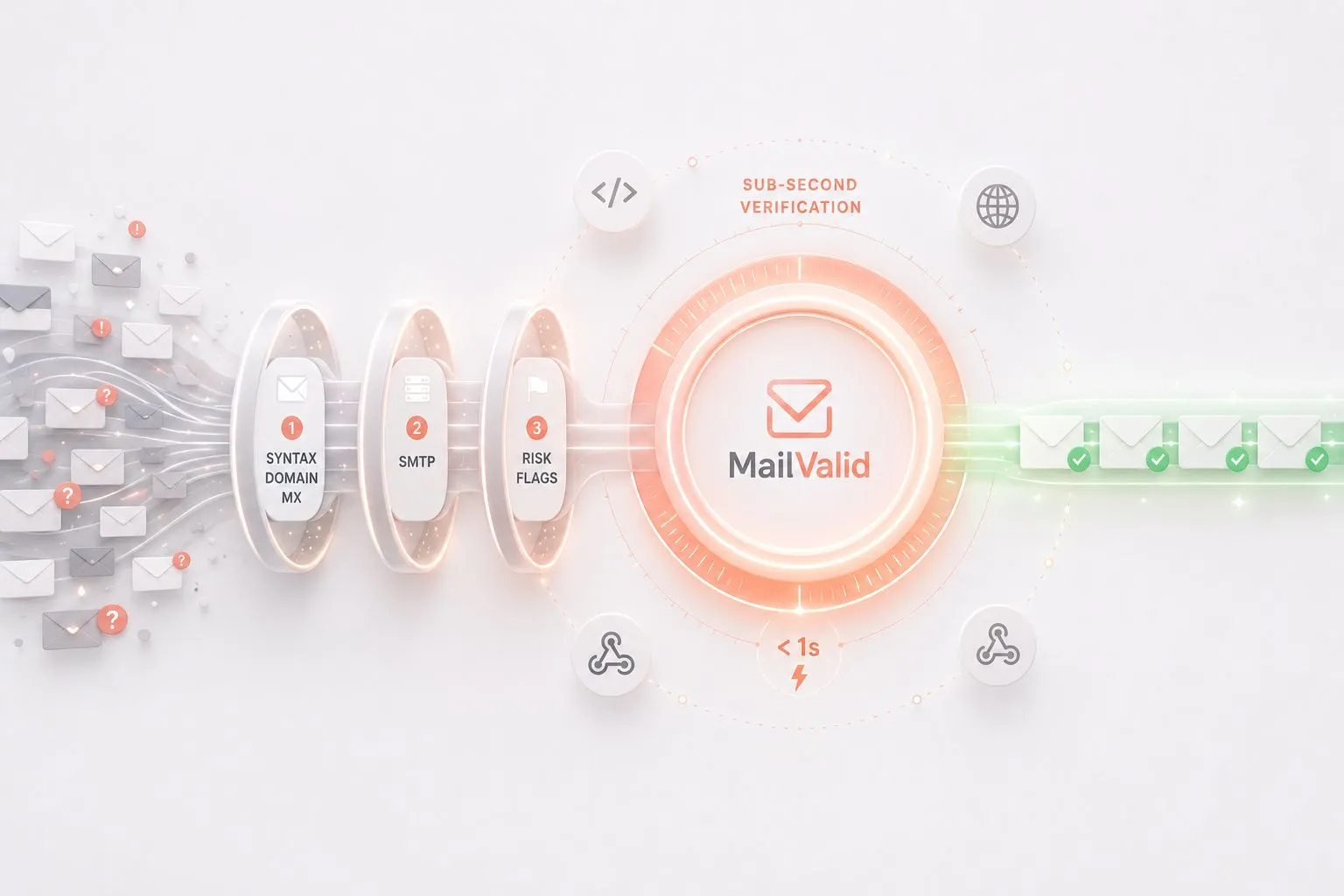 What it does: turns a name into a deliverable email, verifies it, and pushes only clean leads into the campaign - keeping bounce rate under 2%.
This is the step that silently decides whether the whole system works. Scraped and enriched data is messy by nature - exports from LinkedIn, Apollo, and funding databases routinely carry 5–10% invalid addresses. Send to those and you don't just lose individual emails; you tell inbox providers you don't know who you're emailing, and they punish your entire sending domain for it.
The thresholds are unforgiving:
- A bounce rate under 2% is "safe"; the industry average is around 1.98% (Selzy benchmark).
- Senders who hold under 1.5% see 10–12% higher inbox placement.
- Global inbox placement averaged just 83.5% in 2024 - about 1 in 6 legitimate emails never landed (Validity 2025 Benchmark Report).
What it does: turns a name into a deliverable email, verifies it, and pushes only clean leads into the campaign - keeping bounce rate under 2%.
This is the step that silently decides whether the whole system works. Scraped and enriched data is messy by nature - exports from LinkedIn, Apollo, and funding databases routinely carry 5–10% invalid addresses. Send to those and you don't just lose individual emails; you tell inbox providers you don't know who you're emailing, and they punish your entire sending domain for it.
The thresholds are unforgiving:
- A bounce rate under 2% is "safe"; the industry average is around 1.98% (Selzy benchmark).
- Senders who hold under 1.5% see 10–12% higher inbox placement.
- Global inbox placement averaged just 83.5% in 2024 - about 1 in 6 legitimate emails never landed (Validity 2025 Benchmark Report).
So before a single lead enters a campaign, it runs through a verification waterfall: | Layer | What it catches | |---------|----------------| | Syntax + domain + MX | Malformed addresses, dead domains, domains that can't receive mail | | SMTP mailbox check | Addresses that look fine but don't actually exist | | Risk flags | Disposable inboxes, role accounts (info@/sales@), catch-all domains |
MailValid runs that entire stack - syntax, domain, MX, SMTP, and disposable detection - in a single API call, returning a verdict in under 500ms with 95%+ accuracy. It fits this system specifically because it's built for automation, not dashboards: - Real-time or batch verification — Verify a lead instantly as it's enriched, or clean a scraped list with up to 10,000 emails per request.
-
API-first integration - Add a single API call between "append email" and "create lead." Includes examples for Python, JavaScript, PHP, and cURL, plus webhook support.
-
Pay-as-you-go pricing - Just $0.001 per email. Credits never expire, with no monthly minimums, making list verification far cheaper than the cost of damaging your sender reputation.
-
100 free credits - No credit card required. Test it against your dirtiest list before committing.
Skip this layer and every other component leaks. Verify here and the warm leads you fought to find actually reach a human.
6. The personalization prompts (one per signal type)
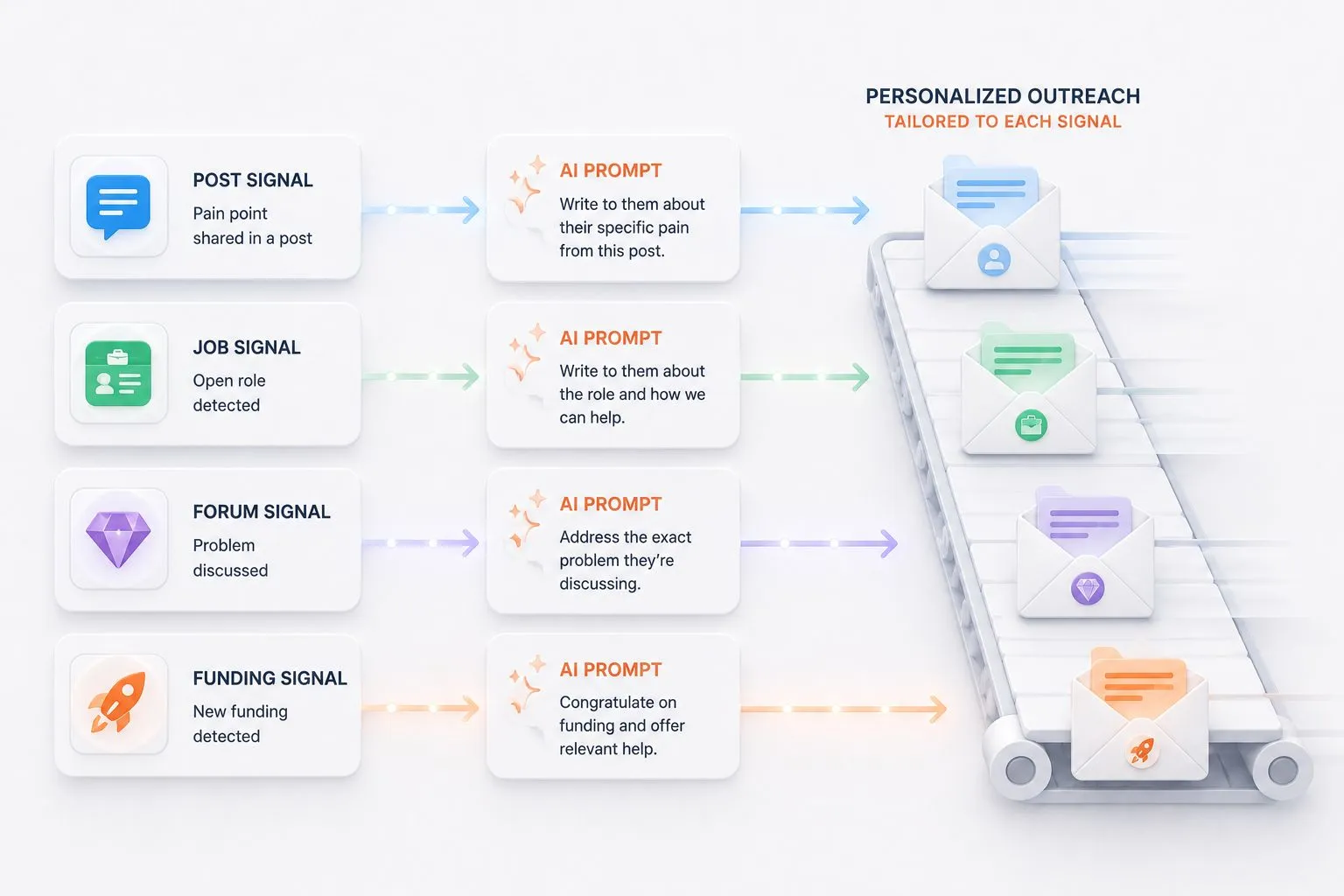 What it does: writes a genuine first line for every lead - batch-processed across 500 leads in under 10 minutes.
Each signal source produces a different kind of context, so each gets its own prompt. The LinkedIn prompt references the post. The job-board prompt references the open role. The Reddit/Quora prompt echoes the vented frustration. The funding prompt references the raise and the growth pressure. Because the verification layer already pushed clean leads with their source context attached, the AI has real material to work with - not "Hi {first_name}, I noticed your company."
The payoff: personalization that reads one-to-one, produced at a speed that makes the whole system worth running.
What it does: writes a genuine first line for every lead - batch-processed across 500 leads in under 10 minutes.
Each signal source produces a different kind of context, so each gets its own prompt. The LinkedIn prompt references the post. The job-board prompt references the open role. The Reddit/Quora prompt echoes the vented frustration. The funding prompt references the raise and the growth pressure. Because the verification layer already pushed clean leads with their source context attached, the AI has real material to work with - not "Hi {first_name}, I noticed your company."
The payoff: personalization that reads one-to-one, produced at a speed that makes the whole system worth running.
7. The sequence structure + diagnostic benchmarks
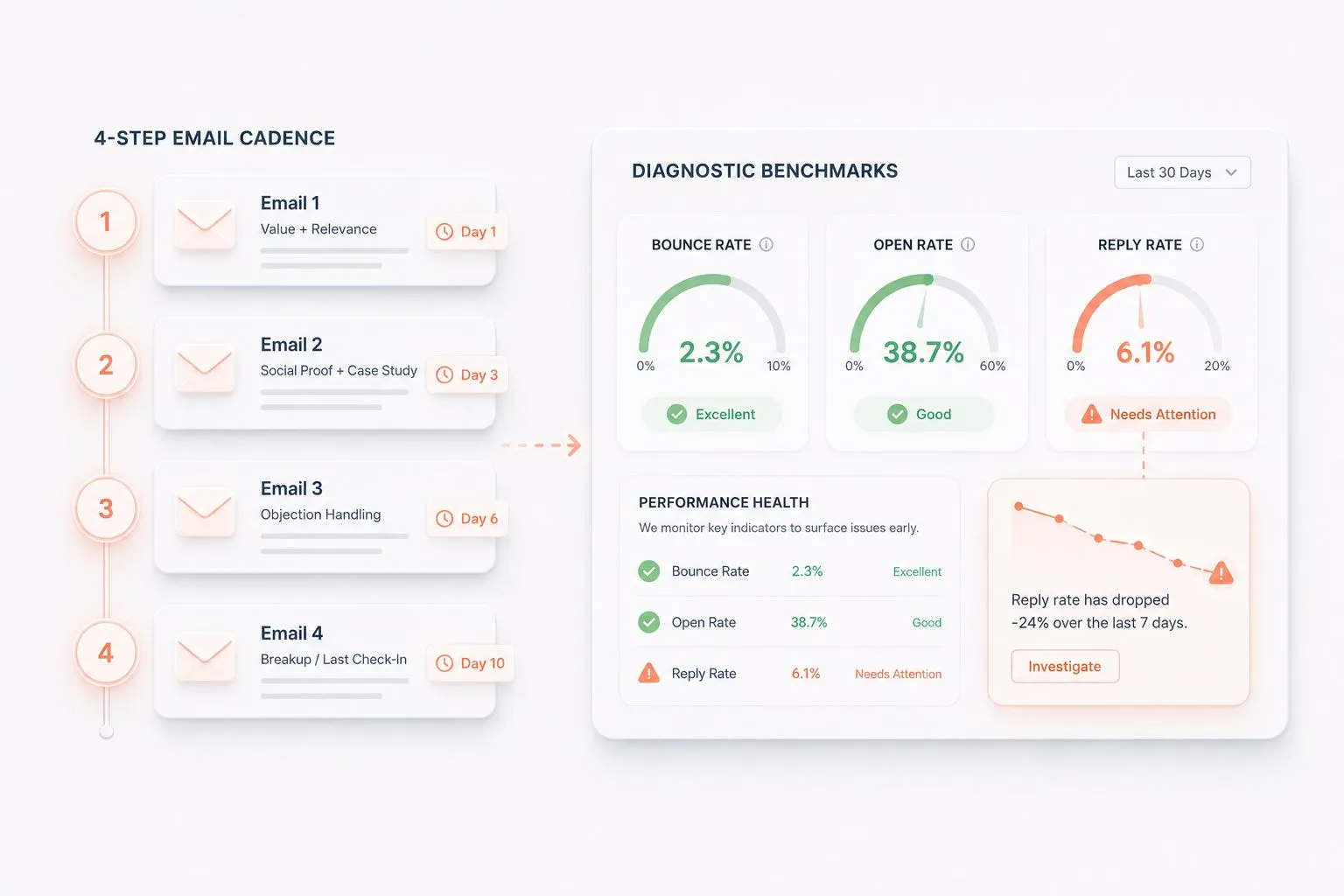
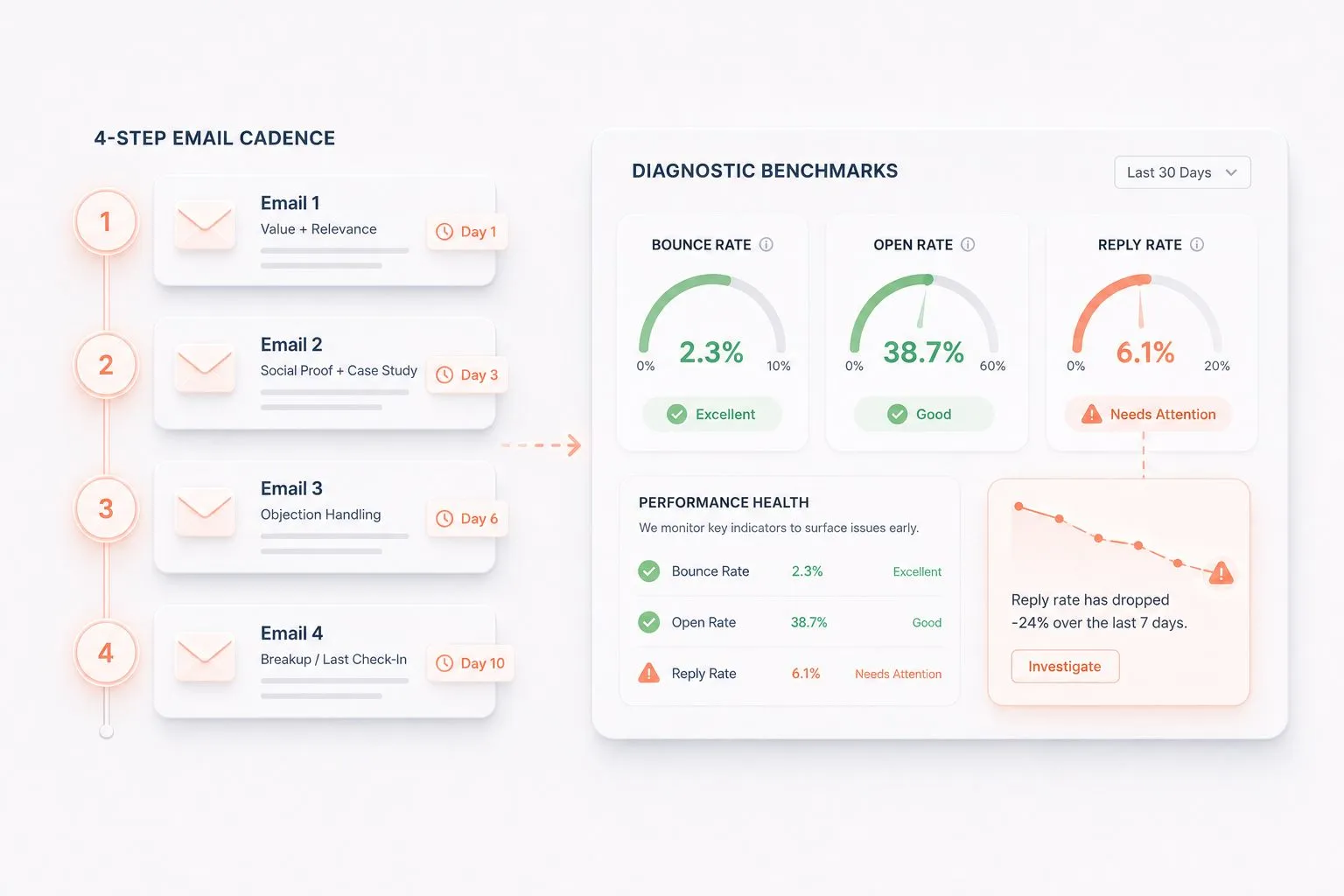 What it does: a 4-email cadence built for warm intent, plus the exact thresholds that tell you what broke when the numbers drop.
Warm leads don't need a 9-touch nurture grind. They need a tight 4-email sequence that opens with their own signal, makes one clear offer, and gets out of the way. Just as important: a diagnostic layer that turns the campaign into a system you can debug. When replies dip, the benchmarks tell you where - bounce rate climbing means a list-quality problem (back to layer 5), opens dropping means deliverability or subject lines, replies dropping with healthy opens means the offer or copy.
The benchmark to watch first: bounce rate. If it creeps over 2%, nothing downstream matters until it's fixed - which is exactly why verification sits at the center of the system, not the edge.
What it does: a 4-email cadence built for warm intent, plus the exact thresholds that tell you what broke when the numbers drop.
Warm leads don't need a 9-touch nurture grind. They need a tight 4-email sequence that opens with their own signal, makes one clear offer, and gets out of the way. Just as important: a diagnostic layer that turns the campaign into a system you can debug. When replies dip, the benchmarks tell you where - bounce rate climbing means a list-quality problem (back to layer 5), opens dropping means deliverability or subject lines, replies dropping with healthy opens means the offer or copy.
The benchmark to watch first: bounce rate. If it creeps over 2%, nothing downstream matters until it's fixed - which is exactly why verification sits at the center of the system, not the edge.
Who this email sequence system is built for
 The same architecture pays off across every team running outbound, for different reasons:
- Founders and agency owners get a repeatable path from signal to booked call - and a deliverability floor that keeps one bad import from halving every campaign's results.
- Email marketers and growth teams protect sender reputation and ESP standing, because verification stops the bounce-and-complaint spikes that get domains throttled.
- SDR and sales teams running Instantly or Smartlead keep their dedicated domains clean and their meetings on the calendar instead of in spam.
- Developers and RevOps get a programmatic pipeline - scrape, enrich, verify by API, push - instead of a stack of manual CSV uploads.
The same architecture pays off across every team running outbound, for different reasons:
- Founders and agency owners get a repeatable path from signal to booked call - and a deliverability floor that keeps one bad import from halving every campaign's results.
- Email marketers and growth teams protect sender reputation and ESP standing, because verification stops the bounce-and-complaint spikes that get domains throttled.
- SDR and sales teams running Instantly or Smartlead keep their dedicated domains clean and their meetings on the calendar instead of in spam.
- Developers and RevOps get a programmatic pipeline - scrape, enrich, verify by API, push - instead of a stack of manual CSV uploads.
FAQ
What is a warm outreach system? A warm outreach system contacts only prospects who've already signaled intent - through social posts, job listings, community discussions, or funding events - then verifies, personalizes, and sequences to them. It replaces high-volume cold sending with timing- and signal-based targeting, which produces higher reply rates from fewer, better-fit sends.
Why does email verification matter in a warm outreach system? Because the intent data feeding the system is scraped and enriched, it carries 5–10% invalid addresses. Sending to those causes bounces, which lower inbox placement for your entire domain. Verifying every address before it enters a campaign keeps bounce rate under 2% - the band where inbox providers trust you and the rest of the system performs.
What's a good bounce rate for this kind of outbound? Under 2% is safe and under 1.5% is ideal - senders below 1.5% see roughly 10–12% higher inbox placement. Above 5% risks domain throttling or suspension.
Can the verification step run automatically? Yes. An API-first verifier like MailValid drops into the pipeline as a single call between enrichment and your sending tool, with real-time checks for single leads and batch processing up to 10,000 emails per request - no manual uploads.
Do I need all seven components to start? No. Most teams start with one signal source (LinkedIn intent or funding is easiest), the verification layer, and a single personalization prompt, then add sources as the system proves out. Verification should never be the part you skip - it's what protects everything else.
The bottom line
Warm outreach is a timing-and-list game disguised as a copy game. The four signal scrapers tell you who and when. The personalization prompts make it feel one-to-one. The sequence turns interest into calls. But none of it reaches a human if the addresses bounce - which is why verification sits at the center of the system, not as an afterthought. Build the signal layer to find intent. Build the verification layer so the intent actually lands. Then let the warm leads come to you, in the inbox, where they can reply.
Ready to protect your sender reputation?
Start with 100 free MailValid credits — no credit card required. Verify your email list before your next campaign, reduce bounce rates, and keep your emails landing in the inbox.
👉 Get started free: mailvalid.io
MailValid Team
Email verification experts
Join teams that verify before they send
Stop letting bad emails hurt your deliverability
100 free credits. From $0.00075/email after. Credits never expire. No credit card required.