
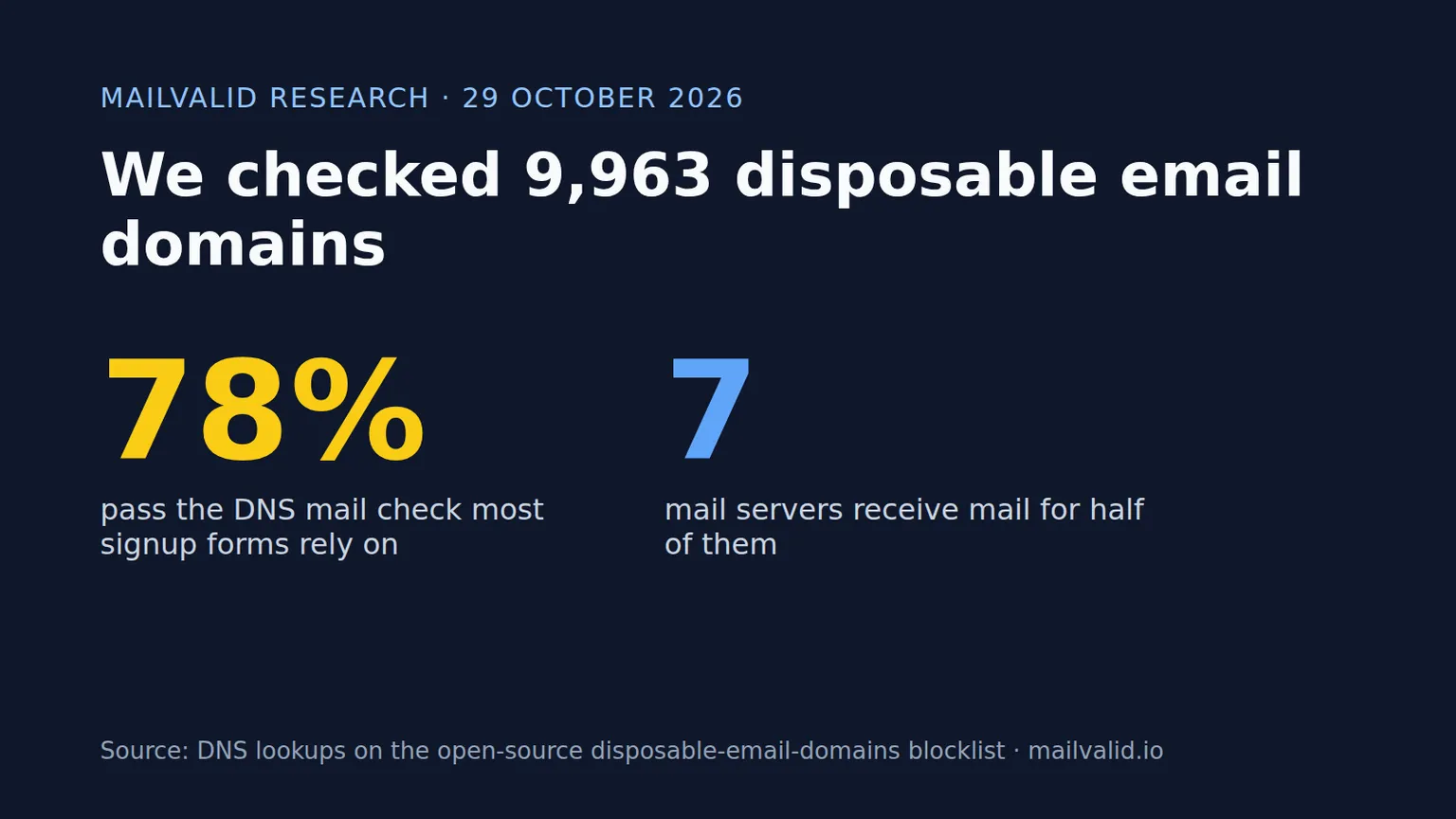
A common way to block fake signups is to check that the email's domain has a mail server (an MX record). If it doesn't, the address can't receive mail, so the signup is rejected.
We wanted to know how well that check stops disposable (temporary) email addresses. So on 29 October 2026 we looked up the DNS records of every domain in the open-source blocklist of disposable email domains on GitHub, disposable-email-domains: 9,963 domains.
Key findings
78.2% pass a DNS mail check. 6,896 domains (69.2%) publish an MX record, and another 894 (9.0%) have no MX but an A record, which mail servers fall back to under RFC 5321.
Half of them receive mail on 7 servers. The primary mail servers of 6,833 domains resolve to 640 IP addresses. Just 7 of those IPs handle 3,436 domains, 50.3% of the total.
New disposable domains are almost all live. Of the 776 domains added to the list between 1 and 27 October, 766 (98.7%) have an MX record.
648 of October's new domains look like small businesses. Their names read like local air-conditioning repair firms, and they all receive mail on one network. In our sample, most were registered on a single day in August, about two months before they reached the blocklist.
Result 1: an MX check stops about 1 in 5 disposable domains
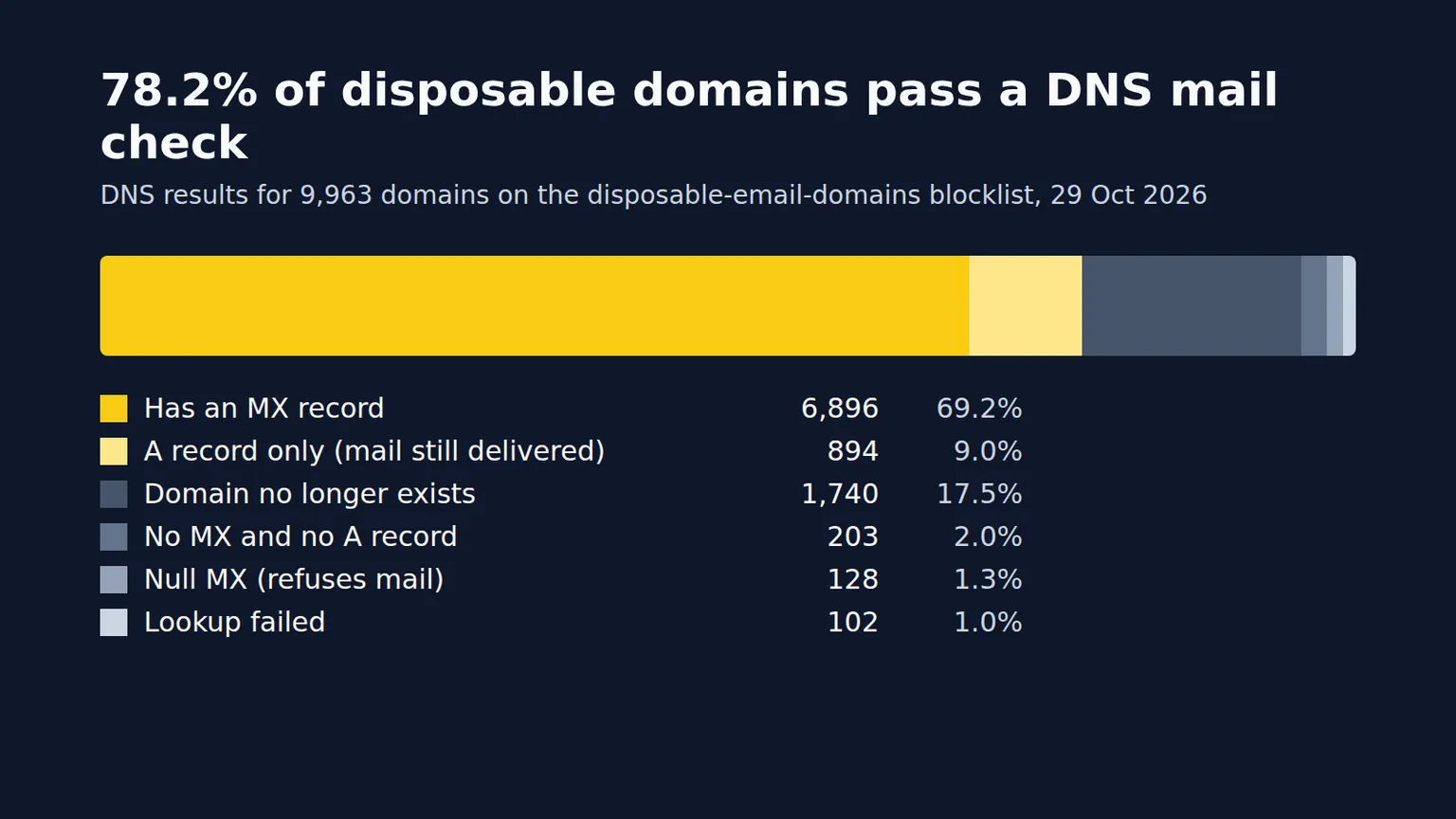
| DNS result | Domains | Share |
|---|---|---|
| Has an MX record | 6,896 | 69.2% |
| No MX, but an A record (mail can still be delivered) | 894 | 9.0% |
| Passes a DNS mail check | 7,790 | 78.2% |
| Domain no longer exists | 1,740 | 17.5% |
| No MX and no A record | 203 | 2.0% |
| Null MX (explicitly refuses mail) | 128 | 1.3% |
| Lookup failed | 102 | 1.0% |
The domains an MX check does stop are mostly dead ones: 1,740 domains on the list no longer resolve at all. Disposable services that are still running pass.
Result 2: seven servers handle half of all disposable domains
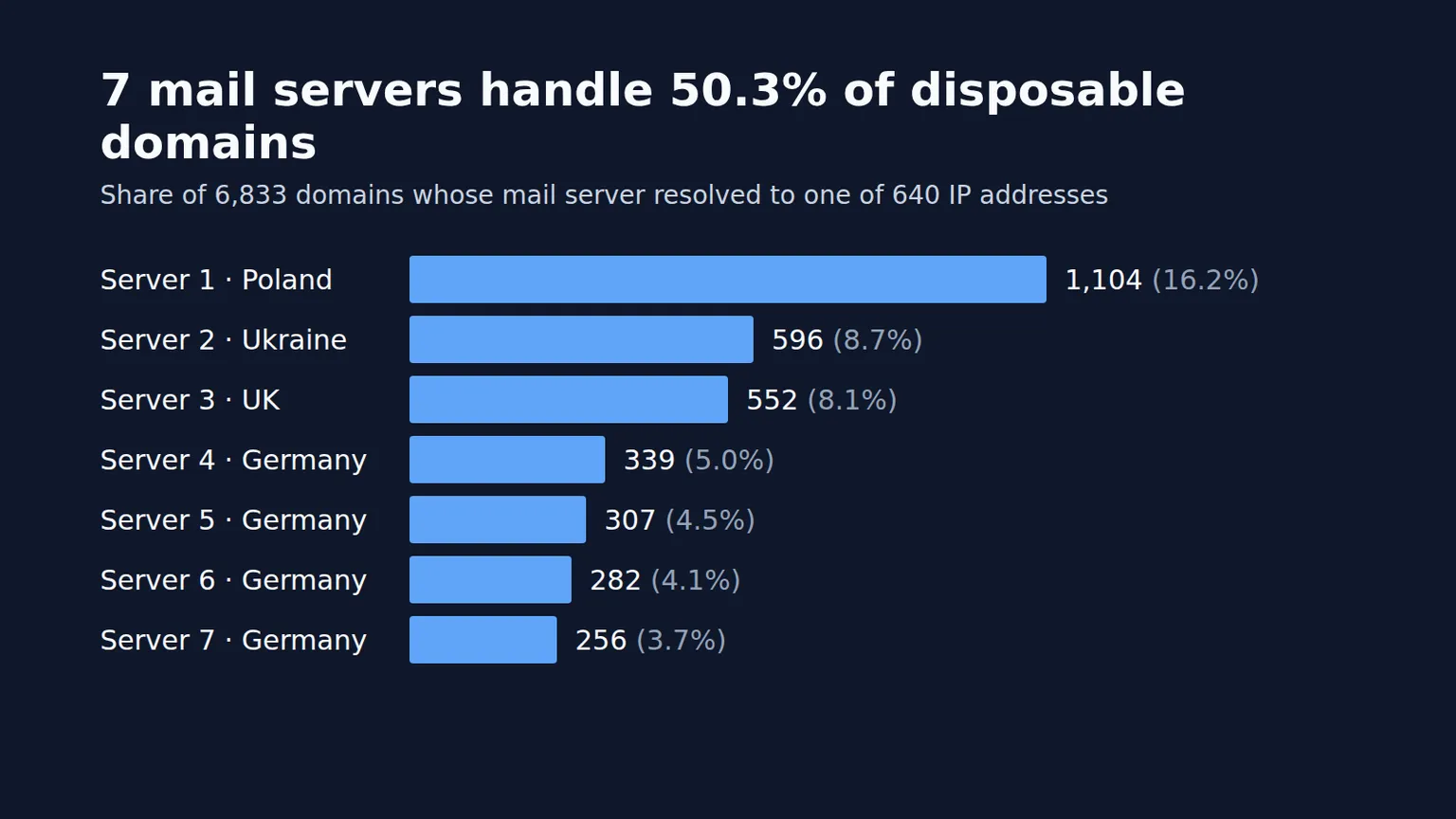
Disposable email services register many domains but run few mail servers. When we resolved each domain's primary mail server to an IP address, the top 7 handled half the list:
| Mail server | Server location | Domains | Share |
|---|---|---|---|
| Server 1 | Poland | 1,104 | 16.2% |
| Server 2 | Ukraine | 596 | 8.7% |
| Server 3 | United Kingdom | 552 | 8.1% |
| Server 4 | Germany | 339 | 5.0% |
| Server 5 | Germany | 307 | 4.5% |
| Server 6 | Germany | 282 | 4.1% |
| Server 7 | Germany | 256 | 3.7% |
Shares are of the 6,833 domains whose primary mail server resolved to an IP address. All seven are rented servers at general hosting providers, which host many unrelated customers, so we don't name the providers.
The largest single server receives mail for 1,104 domains. Some disposable domains also use mainstream mail services that anyone can sign up for: 308 route mail through Cloudflare Email Routing and 82 through Google. That says nothing bad about those services; it means their mail servers can't be used as a disposable signal on their own.
This matters because a blocklist only knows the domains someone has already reported. A new domain pointing at one of these servers isn't on any list yet, but its mail server is already known.
Result 3: the newest disposable domains don't look disposable
Between our downloads on 1 and 29 October, the list grew by 776 domains. 648 of them receive mail on the same small network and were added in a single batch on 12 October.
Their names read like local service businesses, mostly air-conditioning and HVAC repair, often with "24x7" or a city name in them. 517 of them use the .xyz extension. The homepages we checked were empty. We aren't naming individual domains here, because we haven't independently confirmed each one.
We checked registration records for a random sample of 40 (39 answered). 34 were registered in August 2026, 28 of them on the same day, 13 August. They reached the blocklist on 12 October, a gap of about 60 days (calculated). During that window, a signup form relying on the blocklist would have let them through.
What this means for signup forms
An MX check alone isn't disposable detection. It confirms a domain can receive mail. Nearly 4 in 5 disposable domains can.
Blocklists lag behind. New domains appear in batches of hundreds, and in this case reached the list about two months after registration.
Look at where the mail goes, not just the domain name. Checking whether a domain's mail server belongs to known disposable infrastructure catches new domains that no list has named yet.
You can test any domain with our free disposable email checker.
Method and data
Source: disposable_email_blocklist.conf, latest commit 27 October 2026, 9,963 domains.
Lookups: MX records queried for every domain on 29 October 2026 via 1.1.1.1, with failures retried via 8.8.8.8. Domains without MX were checked for an A record. Server locations come from Team Cymru's IP-to-ASN service.
Limits: We didn't open SMTP connections, so "can receive mail" means the domain publishes a mail server in DNS, which is exactly what an MX check tests. Registration dates come from a sample of 40 domains, not all 648. Which domains count as disposable is the blocklist's classification, not ours.
Data: journalists and researchers can request the full dataset by emailing sachin@mailvalid.io.
FAQ
What percentage of disposable email domains have MX records?
In our 29 October 2026 lookup of 9,963 known disposable domains, 69.2% had an MX record. Including domains that accept mail via an A record fallback, 78.2% passed a DNS mail check.
Does an MX record check block disposable emails?
Mostly not. An MX check blocked about 1 in 5 disposable domains in our study, and most of those domains no longer exist. Active disposable services publish working mail servers.
How fast do new disposable domains appear?
The open blocklist we studied added 776 domains between 1 and 27 October 2026. 648 of them were added in one batch and had been registered about two months earlier.
MailValid Team
Email verification experts
Join teams that verify before they send
Stop letting bad emails hurt your deliverability
100 free credits. From $0.0008/email after. Credits never expire. No credit card required.