

Key Takeaways
- Pay-as-you-go and subscription pricing aren't competing for the same use case — pay-as-you-go optimizes for flexibility, subscriptions optimize for volume discounts on steady usage.
- Pay-as-you-go wins for one-time list cleans, irregular volume, and agencies managing multiple clients with different needs each month.
- Subscriptions win when monthly volume is steady and the allotment gets used consistently — the per-email rate can be several times lower than small pay-as-you-go packs.
- Credit expiration policy matters more than most senders realize. Expiring credits (NeverBounce: 12 months) effectively raise the real price paid per email for anyone who doesn't burn through the full batch in time.
- Watch for hidden costs beyond the headline rate: overage pricing, minimum purchase sizes, API rate limits, and features like catch-all detection gated behind higher tiers.
- A provider where pay-as-you-go top-ups and subscription credits share one non-expiring pool — MailValid's model — lets a single account cover both a predictable baseline and unpredictable spikes without losing spend to expiration.
Pay-As-You-Go vs. Subscription: The One-Sentence Answer
Pay-as-you-go email verification means you buy a fixed batch of verification credits once, pay a flat per-email rate, and use them whenever you want with no recurring charge. A subscription means you pay a fixed amount every month for a set number of credits, whether you use them all or not.
Neither model is universally cheaper. The right choice depends on one variable: how predictable your monthly verification volume is. Steady, recurring senders usually save more on a subscription's lower per-email rate. Irregular senders — agencies, list importers, seasonal marketers — usually save more on pay-as-you-go, because they're not paying for unused capacity every month.
How Each Pricing Model Actually Works

Pay-as-you-go works like a prepaid phone card. You buy a block of credits — say, 10,000 or 100,000 — at a set price per email. There's no renewal date and no automatic charge. You use the credits over days, weeks, or months, and when they run out, you buy more. Most providers price pay-as-you-go tiers on a sliding scale: the more credits you buy at once, the lower the per-email rate.
One distinction worth checking before comparing rates: some providers only unlock their advertised pay-as-you-go price for accounts with an active paid subscription. Providers like MailValid, QuickEmailVerification and Emailable, by contrast, sell standalone credit packs with no subscription required — MailValid's one-time packs start at $8 for 2,000 credits. This matters most for the one-time or no-commitment use case in the next section — check whether a provider's PAYG tier actually requires a subscription before assuming it's the flexible, no-strings option.
Subscription works like a SaaS plan. You commit to a monthly (or annual) fee that includes a fixed credit allotment — for example, 50,000 verifications for $40/month. The subscription auto-renews and auto-charges until you cancel. In exchange for the recurring commitment, providers typically offer a lower per-email rate than their own pay-as-you-go tier at the same volume, plus extras like higher API rate limits, catch-all detection, or priority processing.
The trade-off is structural, not cosmetic: pay-as-you-go optimizes for flexibility, subscriptions optimize for volume discounts. Everything else in this comparison follows from that.
The Math: When Pay-As-You-Go Wins
Pay-as-you-go wins whenever your usage is irregular, seasonal, or one-off. Three concrete scenarios:
Scenario 1 — the one-time list clean. You imported a 40,000-contact list from a CRM migration and need to verify it once before your first campaign. A subscription with 50,000 monthly credits at $40/month bills you $40 whether you verify 40,000 emails or zero next month. A standalone pay-as-you-go batch, sized to your actual need, avoids paying for 10,000 credits and 11 more months of subscription you don't need — provided the vendor sells that batch without requiring a subscription. If a provider's PAYG rate is subscription-gated (see the note above), a one-off list clean effectively costs at least one month's subscription fee plus the credits, which changes this comparison.
Scenario 2 — the agency managing multiple clients. An agency verifies 5,000 emails for Client A this week and 60,000 for Client B next month. Volume swings 12x month to month. A fixed subscription tier either under-provisions (forcing overage charges) or over-provisions (wasting credits) almost every cycle. Pay-as-you-go lets the agency buy exactly what each job needs.
Scenario 3 — the seasonal sender. An ecommerce brand verifies heavily before Black Friday and Q4 campaigns, then goes quiet from January through March. Twelve months of subscription billing means paying full price during three dead months. Pay-as-you-go credits that don't expire (see the section below — this detail matters more than the price-per-email) let that spend sit unused without being lost.
The Math: When a Subscription Wins
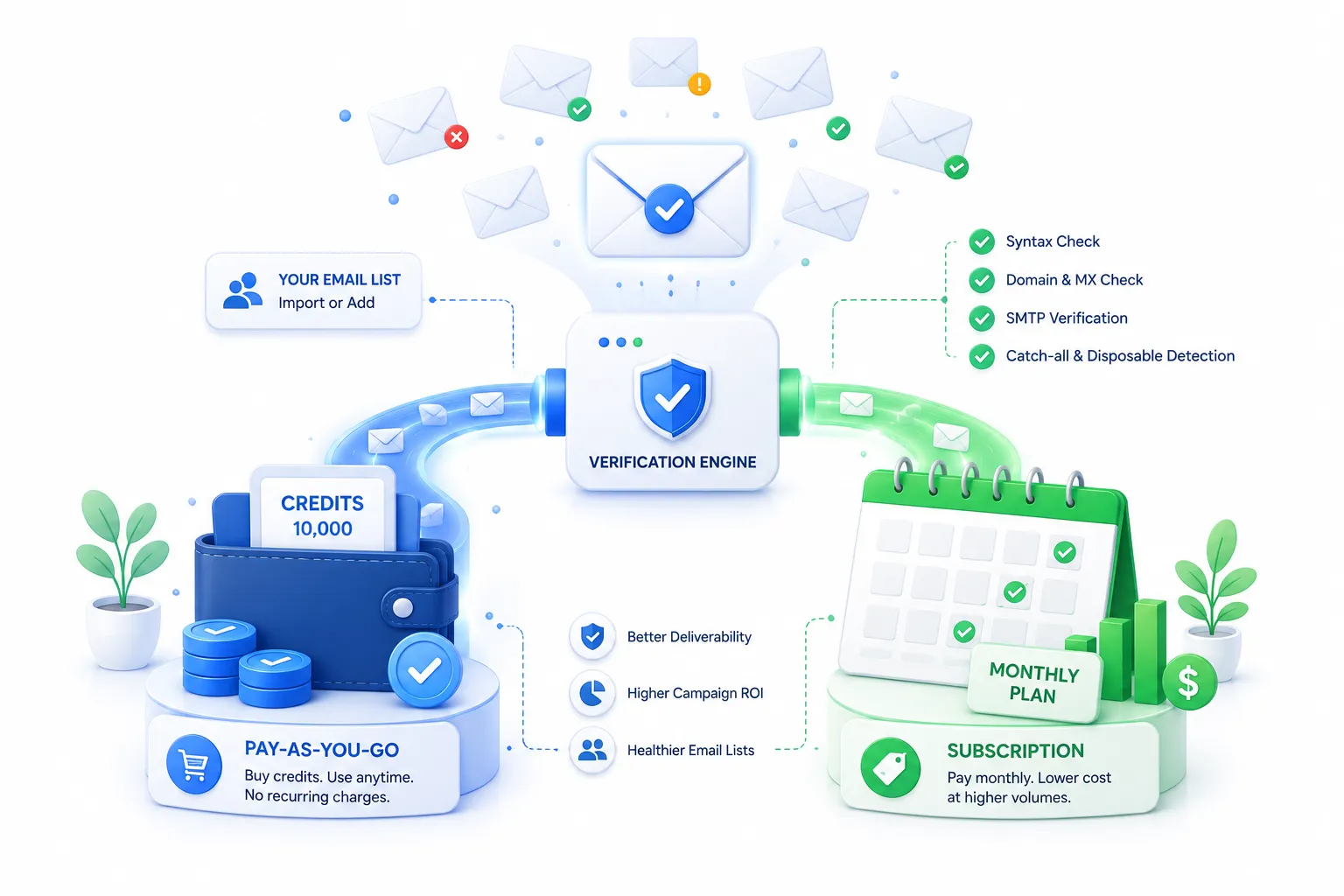 Email Verification Subscriptions win when volume is steady and predictable, because the per-email rate is almost always lower at the same tier. Using MailValid's own published tiers as an example: the smallest pay-as-you-go pack works out to $0.004 per email (2,000 credits for $8), while MailValid Plus drops to $0.00129 per email at 100,000 credits/month ($129/mo) — roughly 3x cheaper per email, because the subscription is priced for sustained volume rather than a single purchase. For totals at 100K, 500K, and 1M addresses, see our bulk verification cost-at-volume breakdown.
That gap holds across the category. A SaaS company verifying 30,000–50,000 new signups every month, on a predictable schedule, will almost always come out ahead on a subscription tier sized to match that volume — as long as they're not consistently buying more capacity than they use. The subscription discount only pays off if the monthly allotment gets used; an oversized plan sitting half-empty every month erodes the advantage fast.
Pricing Comparison Table: 5 Verification Providers
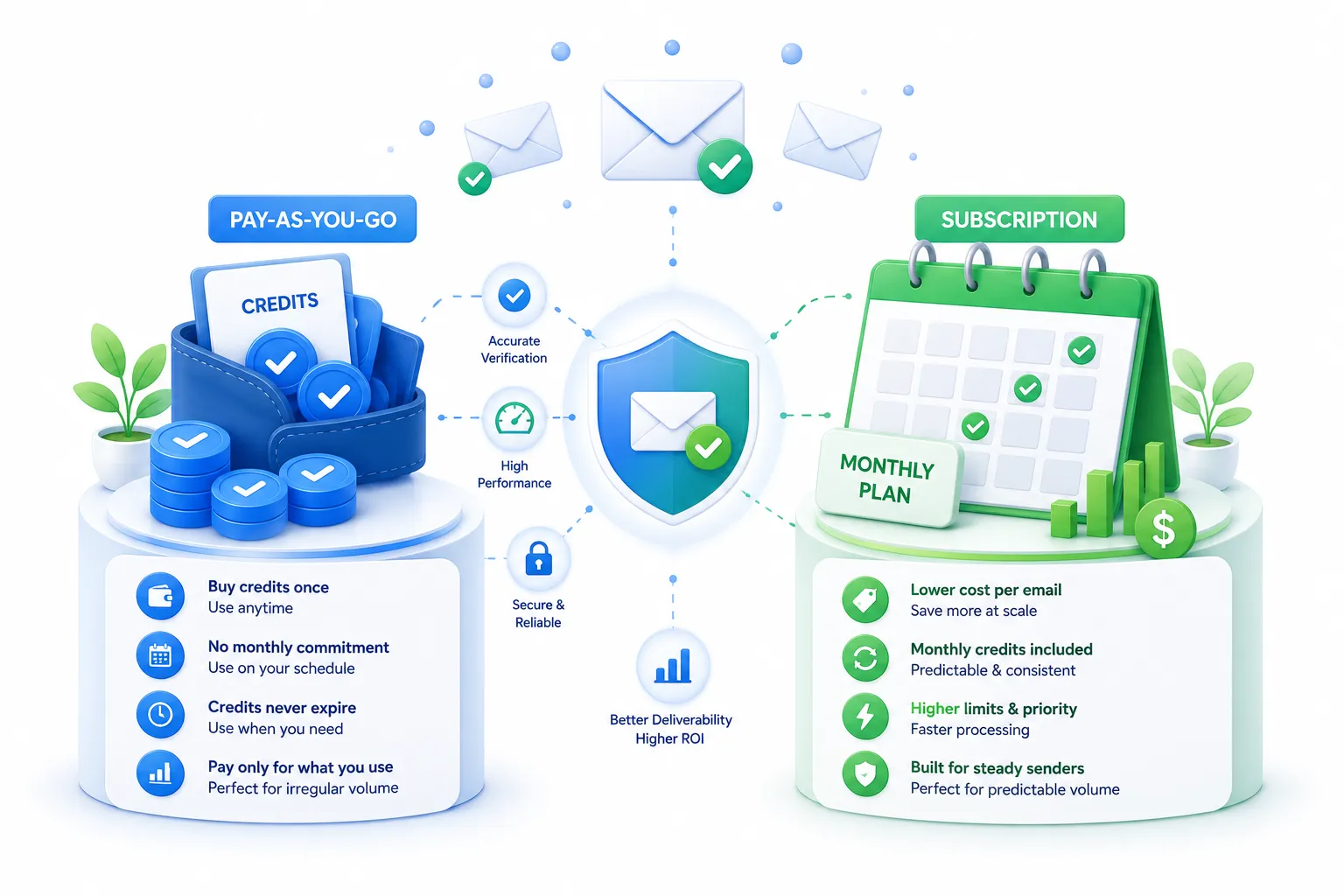 Pricing shown is publicly listed as of July 2026 for a representative mid-volume tier. Rates change; verify current pricing on each provider's site before deciding. Our full breakdown of verification pricing across vendors covers more providers and volume tiers.
| Provider | Pay-As-You-Go Rate | Cheapest Subscription Tier | Credits Expire? |
|---|---|---|---|
| MailValid | From $8 for 2,000 credits ($0.004/email) down to ~$0.0009/email at 1M credits ($899) — no subscription required | $29/mo for 10,000 credits ($0.0029/email, MailValid Plus); ~$0.0008/email at 1M credits/month | Never — on Free, Plus, and pay-as-you-go |
| ZeroBounce | Not published per-tier; 15% off with ZeroBounce ONE | $99/mo (ZeroBounce ONE, from 10,000 credits) | Never expire on Freemium and ONE plans |
| NeverBounce | $0.008/email (≤10K) down to $0.003/email (250K–1M) | $10/mo Essentials, 1,000 verifications ($0.01/email) | Expire after 12 months |
| Emailable | Volume-based, 5,000 credit minimum; exact per-credit rate not published | Subscribe and save 15% vs. pay-as-you-go | Never expire on either plan |
| QuickEmailVerification | From $4 for 500 persistent credits | $0/mo free tier at 100 credits/day; paid daily-credit tiers scale up | Persistent (PAYG) credits never expire; subscription credits reset daily |
Two patterns stand out. First, expiration policy varies more than the headline price — a slightly higher per-email rate with credits that never expire can beat a cheaper rate on credits you lose in 12 months if you don't burn through them fast enough. Second, published pay-as-you-go rates are inconsistently disclosed; several providers only show subscription pricing prominently and push pay-as-you-go buyers toward a sales conversation or a less visible page. That opacity itself is worth factoring into a vendor decision — a provider that hides its pay-as-you-go rate usually wants you defaulting to the subscription.
MailValid's pay-as-you-go packs are one-time purchases with no subscription required, and they share the same non-expiring credit pool as MailValid Plus subscription credits.
The Credit Expiration Problem Nobody Mentions Upfront
Here's the detail that changes this comparison more than any single price point: what happens to unused credits.
If a provider's pay-as-you-go or subscription credits expire — NeverBounce's expire after 12 months, for example — an unpredictable sender can lose money that never shows up as a line item. Buy 100,000 credits for a big list clean, use 60,000 over the next year, and the remaining 40,000 simply vanish. That's a real cost, even though no invoice ever says "$132 forfeited."
Non-expiring credits remove that risk entirely. MailValid, ZeroBounce, and Emailable all publish non-expiring credit policies across their pay-as-you-go and subscription tiers, which means the sticker price is closer to the real price — nothing decays in the background. When comparing per-email rates across providers, treat any provider with expiring credits as effectively more expensive than its listed rate, by whatever share of credits you're realistically likely to leave unused.
Hidden Costs That Change the Comparison
A few line items rarely show up in the pricing table but change the real cost of either model:
Overage charges. Subscriptions with hard monthly caps often bill overages at a much higher per-email rate than the plan's baseline — sometimes close to pay-as-you-go pricing anyway. If overages are common for your volume, you may already be paying pay-as-you-go rates on top of a subscription fee.
Minimum purchase sizes. Several pay-as-you-go tiers have a floor — Emailable requires a 5,000-credit minimum purchase, for instance. A sender who only needs to verify 800 emails this month still pays for 5,000, which changes the effective per-email cost.
Subscription-gated top-ups. Not every "pay-as-you-go" rate is actually available without a subscription. Where a provider's top-up pricing requires an active paid plan, the entry cost for a first-time, no-commitment purchase isn't just the credits, it's the subscription fee too. Confirm whether a provider's advertised PAYG rate applies to a standalone purchase or only to subscribers before using it to price out a one-off job.
Rate limits and batch size caps. Lower-tier plans, whether subscription or pay-as-you-go, often cap API requests per minute and the number of emails per bulk job. A sender verifying large lists on a low tier may need multiple batch submissions or longer processing windows — a time cost, not a dollar cost, but a real one for time-sensitive sends.
Feature gating. Catch-all detection, disposable-email detection, and role-based-address flagging are sometimes reserved for higher subscription tiers. A pay-as-you-go plan priced lower per email but missing catch-all detection can produce a less accurate list — and a dirtier list costs more downstream in bounces and reputation damage than the verification savings were worth. Our ROI math for verifying cold outreach lists quantifies that trade-off.
A Decision Framework: Which Plan Fits Your Sending Pattern
Use this to match your situation to a pricing model rather than defaulting to whichever plan a vendor's homepage pushes hardest.
| Your situation | Better fit | Why |
|---|---|---|
| Verifying a one-time list import or CRM migration | Pay-as-you-go | No reason to commit to a recurring fee for a single job |
| Volume swings more than 3-5x month to month | Pay-as-you-go | Fixed subscription tiers force overage fees or wasted credits most months |
| Steady 20,000+ verifications every month, same range | Subscription | Lower per-email rate pays for itself when volume is consistent |
| Agency managing multiple clients with different volumes | Pay-as-you-go | Buy exactly what each client's job needs, no shared allotment to manage |
| Need catch-all or disposable-domain detection included | Check subscription tiers first | These features are frequently gated above the entry tier |
| Verifying new signups continuously via API | Subscription | Predictable, ongoing usage matches the subscription's intended pattern |
| Uncertain, testing verification for the first time | Free tier or lowest-cost standalone PAYG pack | Lowest commitment; confirm accuracy and fit before scaling to a subscription |
If your volume genuinely straddles both patterns — steady baseline usage plus occasional spikes — look for a provider where subscription and pay-as-you-go top-ups share the same non-expiring credit pool. MailValid fits this case well: the Free tier (100 credits) lets you test accuracy on a small batch with no commitment, a MailValid Plus subscription covers your baseline, and one-time pay-as-you-go packs absorb any spikes above your monthly allotment without anything lost to expiration. The same packs also work on their own for a purely one-off, no-subscription purchase.
Frequently Asked Questions
Is pay-as-you-go or subscription cheaper for email verification? It depends on volume consistency, not just the listed price per email. Subscriptions offer a lower per-email rate for steady, predictable volume. Pay-as-you-go is cheaper overall for irregular or one-off verification needs, because you're not paying a recurring fee for capacity you don't use every month.
Do email verification credits expire? It varies by provider. NeverBounce's credits expire after 12 months. MailValid, ZeroBounce, and Emailable publish non-expiring credit policies across both pay-as-you-go and subscription plans. Always check a provider's expiration policy before comparing price per email — an expiring credit is worth less than a non-expiring one at the same nominal price.
Can I switch from pay-as-you-go to a subscription later? Most providers allow this, and it's a reasonable way to start: verify an initial batch on pay-as-you-go to test accuracy and fit, then move to a subscription once your monthly volume becomes predictable enough to benefit from the lower subscription rate. Note that with some providers this works in reverse, with top-up rates only available to subscribers. MailValid sells standalone pay-as-you-go packs (from $8 for 2,000 credits), so you can start with the free tier or a one-time pack before subscribing.
What's a typical price per email for bulk verification in 2026? Published rates in 2026 range from roughly $0.0008 per email at high-volume subscription tiers (MailValid Plus at 1M credits/month) up to $0.01 per email on low-volume subscription entry tiers (NeverBounce's Essentials plan). Pay-as-you-go rates typically sit between $0.003 and $0.008 per email depending on batch size, before volume discounts.
Does a cheaper per-email rate always mean lower total cost? No. A low per-email rate on a subscription with a large monthly allotment costs more overall than pay-as-you-go if you don't use most of the allotment. Compare total monthly spend against your actual expected usage, not just the headline per-email number.
Do pay-as-you-go plans include the same accuracy as subscriptions? Usually yes for core mailbox verification, but catch-all detection, disposable-domain detection, and role-based-address flagging are sometimes reserved for subscription tiers or higher pay-as-you-go volumes. Confirm which risk-classification features are included before comparing prices, since missing them can lower list accuracy regardless of the price paid.
Not sure which plan fits your volume?
Start on MailValid's free tier to test accuracy on your own list at no cost, then move to a subscription sized to your actual monthly volume — non-expiring top-ups are there to absorb any spikes above your plan's allotment, so nothing goes to waste.
MailValid Team
Email verification experts
Join teams that verify before they send
Stop letting bad emails hurt your deliverability
100 free credits. From $0.0008/email after. Credits never expire. No credit card required.